


If you’ve tried antidepressants 2 or 3 times and are still struggling with depression, you’re not alone, and the next step doesn’t have to be another prescription. TMS is a medication-free, FDA-cleared treatment available right on Medical Center Parkway, with sessions short enough to fit before class, between meetings, or on a lunch break.
You can schedule a free, 15-minute inquiry call to get started.
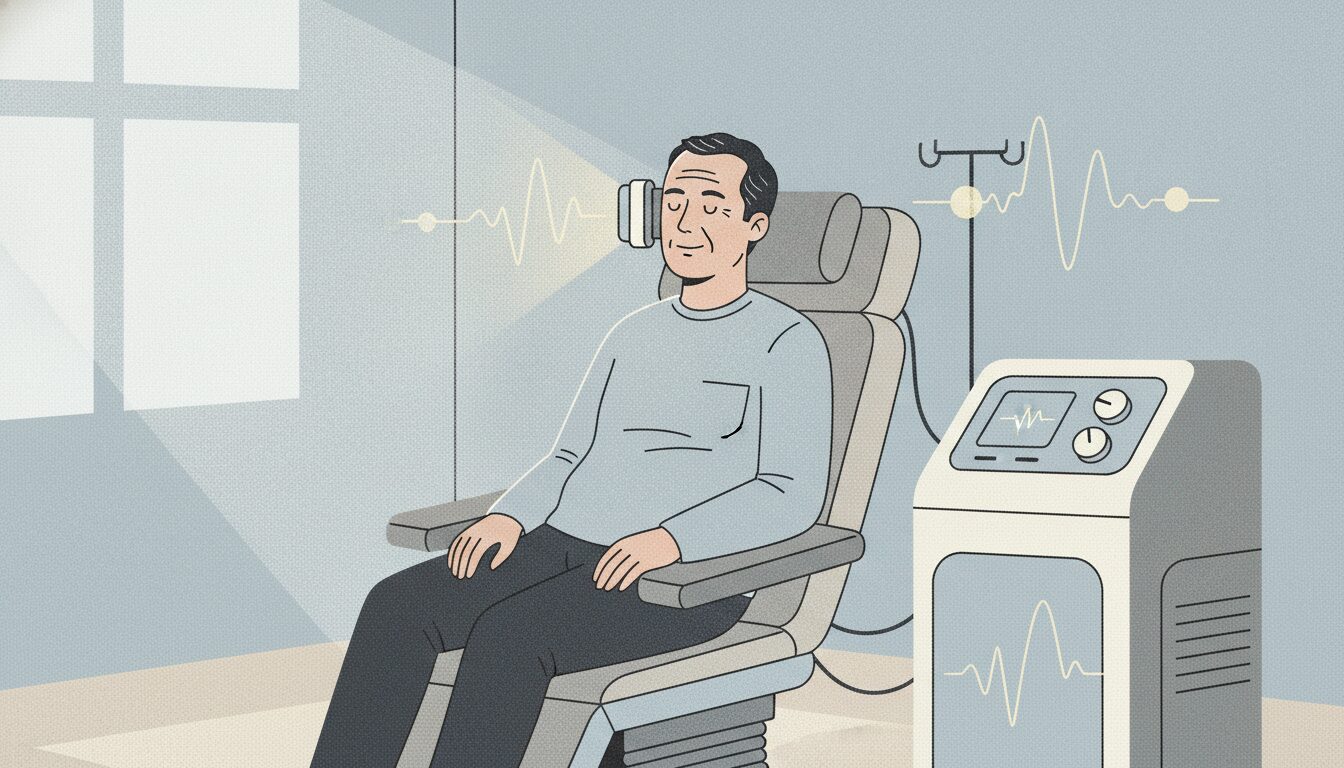
What is TMS and how does it work?
Transcranial magnetic stimulation uses focused magnetic pulses, about 1/30th the strength of an MRI’s field, to gently stimulate the left prefrontal cortex, the mood-regulation region that runs underactive in depression. Repeated sessions help those circuits fire the way they’re supposed to. TMS has been FDA-cleared since 2008 and studied in more than 100 clinical trials [1].
What does a TMS session feel like?
You’ll settle into a recliner, awake the whole time, with earplugs in. The coil rests against your scalp and delivers pulses that feel like light tapping with a rhythmic click. Sessions run 20 to 40 minutes, you can read, email, or watch TV throughout. You drive yourself home after. No anesthesia, no recovery time, no fog.
How long does a full course take?
A standard course is 5 sessions per week for 4 to 6 weeks. It’s a time commitment, and it’s also why we put this clinic where we did: most patients are in and out in under an hour, and Medical Center Parkway makes it an easy stop on a normal day.
Does TMS work?
In large real-world studies of treatment-resistant depression, roughly 50 to 60% of people respond to a full TMS course and about 1 in 3 reach complete remission [2]. We measure your symptoms throughout treatment, so you and your care team know your outcomes for treatment at all times.
At Athena Care, we also track outcomes:
- 88% of Athena Care patients had a clinically meaningful improvement in depressive symptoms and 77% had a clinically substantial improvement
- 66% of Athena Care patients had at least a 50% reduction in symptoms (“responders”)
- 32% of Athena Care patients achieved remission (symptom-free)
- On average, patient depression scores improved by 57%. [3]
Is TMS safe?
TMS is very safe. It’s most common side effect is mild scalp discomfort or a headache in the first sessions, which usually fades within a week. It does not cause weight gain, sexual side effects, insomnia, drowsiness, or memory problems. It isn’t appropriate for people with certain implanted metallic devices near the head, like pacemakers, deep brain stimulators, or non-removable metal; standard dental fillings are fine. Seizures are a rare risk, which is why a trained technician is with you at every session. [1]
How much does TMS cost in Murfreesboro, and does insurance cover it?
Fortunately, most major plans cover TMS for depression once you’ve documented two adequate antidepressant trials plus a course of psychotherapy. We’re in network with Aetna, Ambetter, BlueCross BlueShield of Tennessee, Cigna, Medicare, and UnitedHealthcare, and our team pulls the records together and files the authorization for you, so the criteria are our paperwork problem, not yours. We also offer self-pay options and payment plans for those without insurance.
TMS for college students and young adults
Murfreesboro is a college town, and academic pressure plus depression is a heavy combination. TMS fits student life better than most treatments: no medication side effects to manage mid-semester, 20 to 40 minute sessions that slot between classes, and no downtime afterward. If you’re an MTSU student or the parent of one, reach out and we’ll help you figure out scheduling and insurance, including student plans.
Our Murfreesboro clinic
Athena Care Murfreesboro is at 1639 Medical Center Parkway, Suite 202, Murfreesboro, TN 37129, near Saint Thomas Rutherford with free parking, serving Murfreesboro, Smyrna, La Vergne, and the rest of Rutherford County, Monday through Friday, 7am to 6pm. Reach out through our Care Coordinators at 877-641-1155 or visit the Murfreesboro clinic page for directions. At our Murfreesboro location, we use a Brainsway machine for TMS treatment.
Meet our Chief Medical Officer
Athena Care’s Chief Medical Officer is the psychiatrist Dr. Amanda Sparks-Bushnell, M.D. She oversees Athena Care’s TMS program.

Dr. Amanda Sparks-Bushnell is a Board-Certified Psychiatrist who maintains a heartfelt commitment to transformative leadership and patient well-being. Her career is marked by a passion for enhancing medical services, fostering collaboration, and ensuring the utmost care for those she serves.
Frequently asked questions about TMS in Murfreesboro
How long does each TMS session take?
20 to 40 minutes. Most people are back to their day within the hour.
Does TMS hurt?
It feels like tapping on the scalp with a clicking sound. Early-session scalp tenderness or headaches usually fade within the first week.
Can I drive myself to appointments?
Yes. TMS involves no sedation, so you drive yourself to and from every session.
What are the requirements for insurance to cover TMS?
Most insurers want documentation of at least 2 antidepressant trials at adequate doses plus a course of psychotherapy. Our team pulls that together and files it for you.
Is TMS the same as electroconvulsive therapy (ECT)?
No. ECT uses electrical currents under anesthesia; TMS uses magnetic pulses while you’re fully awake, with no memory side effects and no recovery time.
What if TMS isn’t enough?
Then the next step is a conversation, not a referral across town: Spravato, ketamine, medication adjustments, and therapy all live in the same clinic with the team that already knows your history.
One more thing, because it matters: if you’re in crisis right now, don’t wait for an appointment. Call or text 988 to reach the Suicide & Crisis Lifeline, available 24/7.
Contact us today
Visit Us
Address
1639 Medical Center Parkway
Suite 202
Murfreesboro, TN 37129
Phone: (615) 320-1155
Fax: (615) 320-1177
Hours
M-F 7:00am – 6:00pm
Languages
English, Español
[1] Mayo Clinic, Transcranial Magnetic Stimulation, including FDA approval status and risks (Apr. 2023): https://www.mayoclinic.org/tests-procedures/transcranial-magnetic-stimulation/about/pac-20384625
[2] Carpenter, L. L., et al., Transcranial Magnetic Stimulation (TMS) for Major Depression: A Multisite, Naturalistic, Observational Study of Acute Treatment Outcomes in Clinical Practice, Depression and Anxiety, 29(7): 587-596 (Jul. 2012): https://pubmed.ncbi.nlm.nih.gov/22689344/
[3] Athena Care, internal TMS outcomes data (as of Oct. 2026): based on 82 patients treated with TMS in the last 3 years who received a minimum of 30 treatments and had at least 3 PHQ-9 scores recorded during treatment.
[i] Based on 82 patients treated with TMS in the last 3 years receiving a minimum of 30 treatments and having at least 3 PHQ-9 scores during treatment.