


If you’ve been researching ketamine for depression in Nashville, you’ve probably noticed the search results are crowded with standalone ketamine clinics, places that do infusions and little else. If you have treatment-resistant depression and you’re ready to try ketamine, those clinics can administer it. But there’s a meaningful difference between getting ketamine at an infusion storefront and getting it inside a complete mental health practice, and that difference is the reason to consider Athena Care.
This page explains what sets integrated ketamine care apart, what conditions we treat, how IM ketamine and Spravato differ, what a session is actually like, and the cost and insurance realities, written for someone who’s ready to take the next step.

The integration difference
A standalone ketamine clinic offers one tool: infusions. If ketamine is the right answer for you, that may be fine. But if it isn’t, or if it’s only part of the answer, a clinic that only does infusions has only one thing to sell you.
Athena Care approaches ketamine differently, as one option within a full interventional psychiatry program that also includes psychiatry, therapy, TMS, and Spravato. That matters in concrete ways:
- You get matched to the right treatment, not the only treatment. Our team can assess whether ketamine, Spravato, TMS, a medication adjustment, or a combination is the best fit for your specific situation, because we offer all of them.
- Psychiatry is built in. Your ketamine treatment is overseen by psychiatrists who manage your overall care, not delivered in isolation from the rest of your mental health treatment.
- Therapy and integration are available. Ketamine’s benefits are often consolidated through therapy that helps you process and apply the experience, the “integration” piece that standalone infusion clinics typically don’t provide.
- Continuity of care. When your ketamine series ends, you don’t fall off a cliff, you stay within a practice that manages your ongoing treatment.
For the full clinical picture, see our ketamine for depression page.
What we treat with ketamine
Ketamine is used primarily for treatment-resistant depression (TRD), depression that hasn’t responded to at least two adequate antidepressant trials. It works through the glutamate system rather than the serotonin pathway most antidepressants target, which is why it can work when other medications haven’t, and why it often works fast, within hours to days rather than weeks.
Beyond TRD, ketamine may also benefit severe anxiety and some cases of PTSD, and its rapid action makes it particularly relevant for people in acute distress. Whether ketamine is right for your specific situation is exactly the kind of question our integrated assessment is designed to answer.
IV ketamine vs. Spravato, plainly
These are related but distinct, and the differences matter for cost, coverage, and experience:
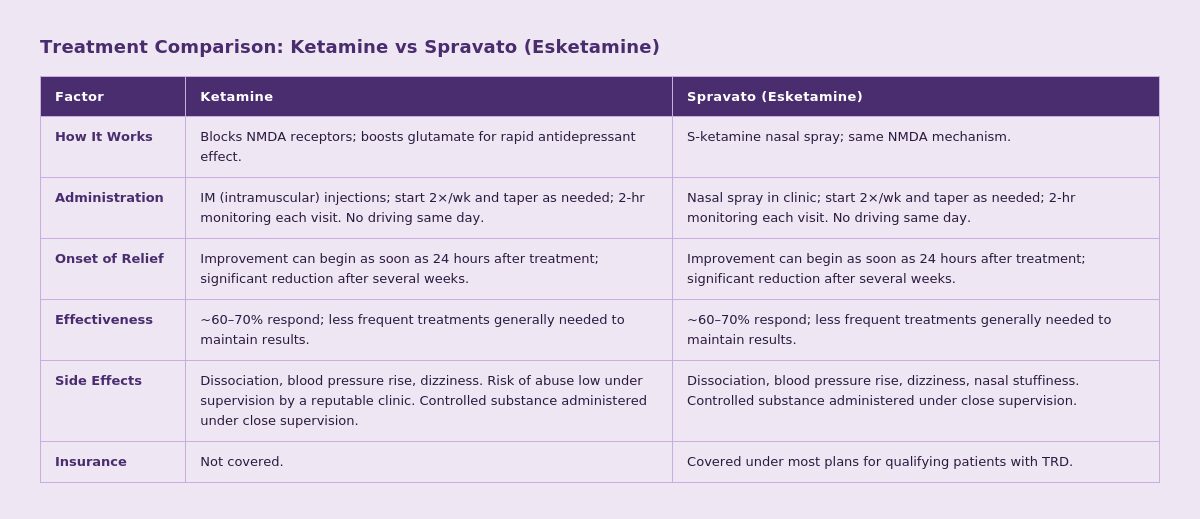
Neither is simply better, they’re different tools. Spravato’s FDA approval and insurance coverage make it the more accessible starting point for many people, while IV/IM ketamine offers dosing flexibility some patients and physicians prefer. Our team can help you weigh them based on your clinical picture and your coverage.
What a session is actually like
Whichever form, the experience has a similar shape. You’ll be in a comfortable, monitored setting, reclining in a chair, with licensed medical and mental health professionals present throughout, this monitoring (sometimes called “trip-sitting”) is a core part of safe ketamine care, not an afterthought.
During the roughly 40 minutes of active effects, most people experience a dissociative state: a sense of detachment from your body and surroundings, altered perception of time and space, and sometimes a feeling of floating or of seeing things from a new vantage point. For most people it’s not frightening, especially in a calm, supported setting, and some find it meaningful. After the active phase, you’ll have an observation period (around one to two hours total) before you’re cleared to go, and you’ll need someone to drive you home.
The integration session afterward, processing the experience with a therapist, is where the integrated model shows its value. Rather than simply sending you home after the drug wears off, integrated care helps you consolidate whatever the experience surfaced into lasting change.
Cost and insurance reality
Here’s the straight version:
- IM ketamine are usually out-of-pocket, because racemic ketamine is used off-label for depression and most insurers don’t cover it for this purpose.
- Spravato is usually insurance-covered, because it’s FDA-approved for treatment-resistant depression. Most major plans cover it with prior authorization for patients who have treatment-resistant depression.
This cost difference is one of the most practical reasons many people start with Spravato, and it’s a conversation our care coordinator can walk you through for your specific insurance before you commit to anything. For Ketamine, we charge $350 per infusion. (Note that the industry range goes up to $500 per infusion.)

Safety
Ketamine has a well-established safety profile when administered in a monitored medical setting. Common, transient effects include a temporary rise in blood pressure, the dissociative experience itself, and sometimes nausea, all monitored and managed during your session. Ketamine isn’t appropriate for everyone; uncontrolled high blood pressure, a history of certain psychotic disorders, and some substance-use concerns can be contraindications. This is another reason integrated psychiatric oversight matters: your suitability is assessed by clinicians who know your full history.
Where to start in Nashville
Our Nashville location, the hub for our interventional psychiatry program, is at 220 Athens Way, Suite 104, Nashville, TN 37228, just off I-65 and convenient from across Middle Tennessee.
To find out whether ketamine, Spravato, TMS, or another approach is the right next step, call our care coordinator at 877-641-1155, Monday through Friday, 7am to 6pm. You can also reach our interventional psychiatry team directly at 615-861-1000 or [email protected].
There’s no obligation in making the call, the goal is to figure out, with a team that offers every option, what’s most likely to help you.
Frequently asked questions
Where is Athena Care’s ketamine clinic in Nashville? Our interventional psychiatry hub is at 220 Athens Way, Suite 104, Nashville, TN 37228, just off I-65, convenient from across Middle Tennessee.
What’s the difference between ketamine and Spravato? IM ketamine is racemic ketamine used off-label and usually paid out-of-pocket. Spravato (esketamine) is an FDA-approved nasal spray for treatment-resistant depression that’s usually insurance-covered. They’re related but distinct, and we can help you choose based on your situation and coverage.
Is ketamine covered by insurance? IM ketamine is usually out-of-pocket because it’s used off-label. Spravato is usually insurance-covered because it’s FDA-approved. Our care coordinator can verify your specific coverage.
What does a ketamine session feel like? Most people experience a dissociative state, a sense of detachment and altered perception, during about 40 minutes of active effects, in a calm, monitored setting. After an observation period, you’ll need someone to drive you home.
What conditions does ketamine treat? Primarily treatment-resistant depression. It may also help severe anxiety and some cases of PTSD, and its rapid action is valuable for people in acute distress.
Is ketamine safe? It has a well-established safety profile in a monitored medical setting. Side effects (temporary blood pressure rise, dissociation, nausea) are monitored during the session. It’s not right for everyone, which is why psychiatric assessment of your suitability matters.
Why choose an integrated practice over a standalone ketamine clinic? Because you get matched to the right treatment among many options (ketamine, Spravato, TMS, medication), with built-in psychiatry, therapy and integration support, and continuity of care, rather than infusions in isolation.
If you’re in Tennessee, reach our Care Coordinator at 877-641-1155, Monday through Friday, 7am to 6pm.
Contact us today
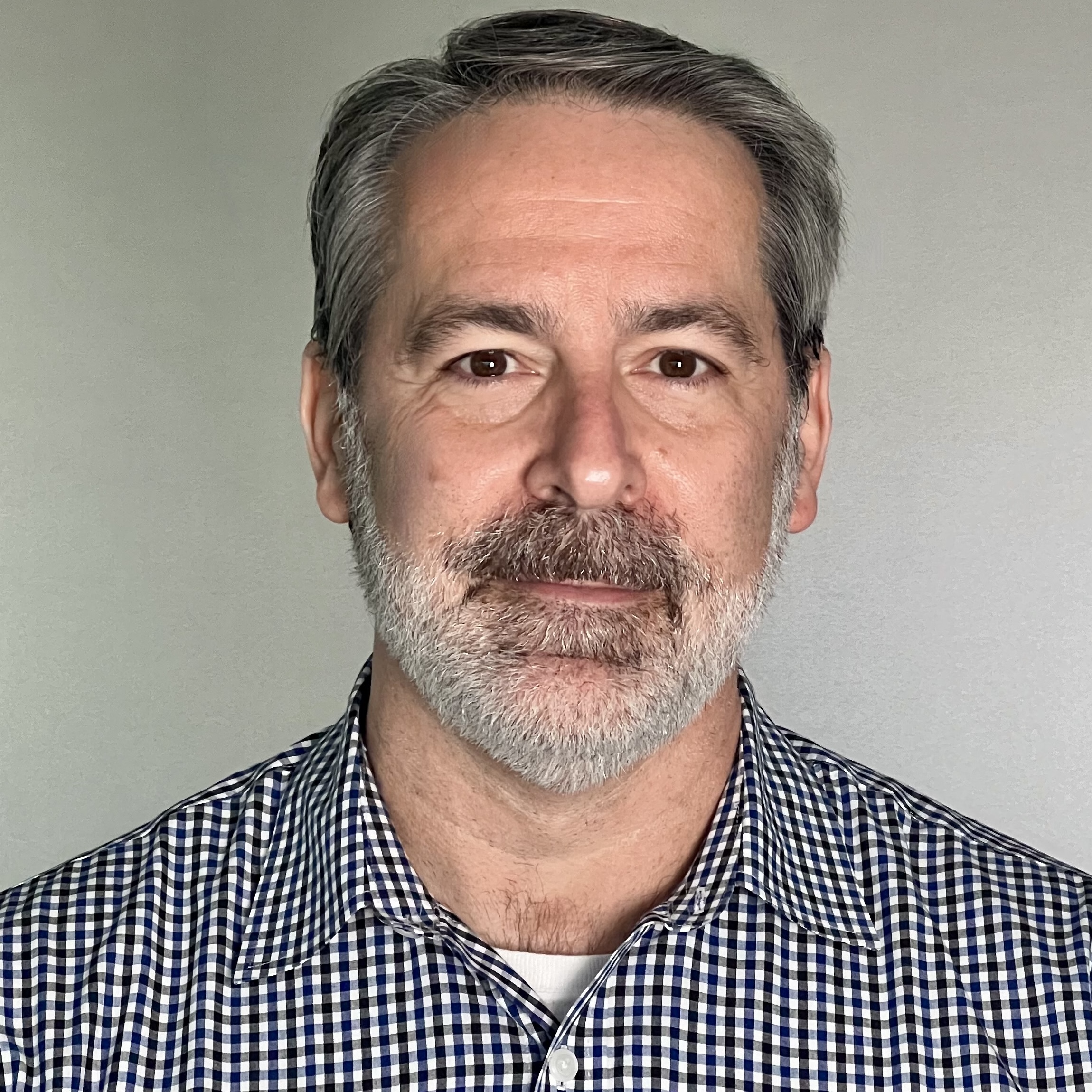
Dr. Jack L Koch Jr., M.D.
Psychiatrist
Dr. Koch obtained his undergraduate degree at the University of South Alabama, obtained his medical degree at the University of South Alabama College of Medicine, completed his Internship and Residency in General Psychiatry at the Vanderbilt University Medical Center, and completed his Fellowship in Child and Adolescent Psychiatry at the Vanderbilt University Medical Center. During his last year at Vanderbilt University Medical Center, he served as Chief Fellow for the Division of Child and Adolescent Psychiatry.

Meg Stein, CFP
Editor
Meg is a certified mindfulness instructor and works at Alive and Aware Practice in Durham, NC. She has over ten years of experience as a content creator and marketing consultant, working in mental healthcare and social justice.