

Understanding Advanced Depression Treatments for Hard-to-Treat Depression
When standard antidepressants and therapy aren’t enough, hope is not lost. For people with treatment-resistant depression (TRD), newer interventions like Ketamine, Spravato (esketamine) nasal spray, and Transcranial Magnetic Stimulation (TMS) offer promising alternatives. These advanced treatments work in different ways – from to stimulating brain circuits – but all aim to relieve severe depression symptoms when traditional treatments have failed. This guide will explain each therapy, compare their mechanisms, administration, effectiveness, side effects, and costs, and help you consider which option might be the best fit. Athena Care offers all three treatments in Tennessee, and our team is here to help you navigate your choices with expert consultation and compassionate support.
Jump to comparison chart

Therapy (Off-Label): Ketamine is an anesthetic medication discovered over 50 years ago, now used at low doses to rapidly alleviate depression. It’s given by under medical supervision. While not originally approved for depression, ketamine are an “off-label” therapy shown to improve mood in many TRD patients.
Spravato® (Esketamine) Nasal Spray: Spravato is the brand name for esketamine, a chemical cousin of ketamine. It’s the first FDA-approved ketamine-based treatment for depression, indicated for adults with TRD or major depression with suicidal ideation. Administered as a nasal spray in a certified clinic, Spravato works similarly to ketamine in the brain but is a more targeted form (using only the “S” enantiomer of ketamine).
Transcranial Magnetic Stimulation (TMS): TMS is a completely medication-free, FDA-cleared treatment for depression that uses magnetic pulses to stimulate specific brain regions involved in mood regulation. It’s a non-invasive procedure (no surgery, no medication) performed in a clinic while you remain awake. By directly underactive neural circuits in the brain, TMS can help “reset” brain activity to lift depression symptoms.
In the sections below, we’ll dive deeper into how each treatment works, what the process is like, how effective they are, their side effects, and practical considerations like cost and insurance coverage. We’ll also include a handy comparison table to summarize the key differences. Our goal is to reduce confusion and empower you with knowledge so you can make an informed decision about your mental health care.
Mechanism of Action: How Each Treatment Works
Ketamine: Ketamine works through a novel mechanism compared to typical antidepressants. It targets the N-methyl-D-aspartate (NMDA) receptors in the brain (part of the glutamate neurotransmitter system). By blocking NMDA receptors, ketamine triggers a surge in glutamate release, which in turn stimulates new neural connections (neuroplasticity) and resets neural circuits involved in mood and thought patterns. This is believed to rapidly improve depressive symptoms even when other medications (which often target serotonin or other pathways) have failed. In practice, many patients notice mood improvements within hours or days of a ketamine – a much faster onset than traditional antidepressants.
Spravato (Esketamine): Esketamine is chemically very similar to ketamine, and its mechanism is largely the same – targeting NMDA receptors to boost glutamate and foster neural circuit changes. The key difference is that Spravato uses only the “S” enantiomer of ketamine, which binds more tightly to NMDA receptors. This means esketamine is about twice as potent as regular ketamine, so effective doses are lower. Spravato’s developers hoped the more refined S-ketamine might cause fewer side effects, though evidence hasn’t shown a large difference in side effect profile. Like IV ketamine, Spravato rapidly affects brain chemistry and can relieve depressive symptoms within 24-48 hours of a dose in some patients. Importantly, Spravato must be used in conjunction with a traditional oral antidepressant, not on its own – it is an augmenting therapy to boost overall treatment effects.
Transcranial Magnetic Stimulation: TMS works on an entirely different principle: physics instead of pharmacology. During TMS, an electromagnetic coil placed against the scalp delivers pulses of magnetic energy to specific brain areas (typically the left dorsolateral prefrontal cortex, a region that modulates mood and is underactive in depression). The magnetic pulses painlessly induce small electrical currents in the targeted brain tissue, stimulating the neurons and helping to “wake up” circuits that are sluggish in depression. Over a course of treatment, repeated stimulation is thought to strengthen these neural pathways and restore healthier activity patterns in the mood-regulating parts of the brain. In essence, TMS gradually resets the brain network involved in depression. Because TMS acts directly on brain cells without any drugs, it does not have the systemic chemical effects that medications do. This unique mechanism makes TMS a valuable option, especially for individuals who either did not benefit from medications or could not tolerate their side effects.
Administration & Treatment Process
Ketamine for depression is typically given via in a medical office or clinic. followed by a recovery/observation period () while the acute effects wear off. Patients sit in a comfortable chair and may wear an eye mask or listen to music during the infusion, as the experience can include mild dissociation (altered consciousness). A healthcare professional monitors vital signs (blood pressure, heart rate, oxygen) throughout. Ketamine are usually done as a series: most protocols recommend an initial series of 6 to 8 spaced out over 2-4 weeks (e.g. two per week). This induction phase helps determine if the patient responds to ketamine. If effective, booster may be given on a maintenance schedule (perhaps monthly or as needed) to sustain the benefits. Because ketamine is a controlled substance and can cause short-term side effects, patients must arrange a ride home – you should not drive until the day after an, due to possible lingering dizziness or sedation. Overall, the process is fairly time-limited (about 2 hours per visit) and the rapid relief can be a lifeline for those in severe depression.
Spravato (Esketamine) Nasal Spray: Spravato is administered in a doctor’s office or clinic that is specifically certified in the Spravato REMS program (a safety monitoring program). The patient self-administers the nasal spray under supervision: Spravato comes in single-use nasal spray devices. A typical session involves the patient using two devices (one spray per nostril from each) to deliver a full dose (56 mg or 84 mg total, depending on the prescribed dose). After spraying, you’ll rest in a comfortable room at the clinic for at least 2 hours of observation. Medical staff will monitor your blood pressure and assess for any adverse reactions until any immediate side effects (like dissociation or blood pressure changes) subside. Because Spravato can cause sedation and dissociation, you cannot drive or leave alone – you’ll need someone to drive you home after each treatment, and you should take it easy for the remainder of the day. Spravato is usually given twice weekly for the first 4 weeks (induction phase), then once weekly for another 4 weeks, and then weekly or every two weeks as maintenance if it’s working. Each session, from check-in to discharge, might last around 2.5 to 3 hours including prep and post-dose monitoring. Like ketamine infusion, Spravato’s advantage is its quick administration (actual dosing is done in minutes) and potential for fast relief, but it requires a time commitment at the clinic and adherence to safety protocols.
Transcranial Magnetic Stimulation: TMS treatments are more frequent but much shorter in duration per session. A typical course for depression involves 5 sessions per week (once each weekday) for about weeks. Each daily session lasts around 20 minutes (with some newer protocols like theta-burst TMS lasting as little as 3-10 minutes per session). During the session, you sit comfortably in a chair without any sedation. A TMS technician or doctor positions the magnetic coil on your head (targeting the left frontal area). You’ll hear clicking sounds and feel a tapping sensation on the scalp as the magnetic pulses are delivered, but the procedure is generally well tolerated. You remain fully awake and alert; many patients pass the time by listening to music or watching TV. One of the biggest conveniences of TMS is after each session, you can immediately resume your normal activities – even drive yourself home or back to work. There’s no recovery downtime needed because there’s no systemic drug effect. However, the therapy requires a significant time commitment: typically 20-30 sessions over the course of a month or more. Some clinics (including Athena Care) offer flexibility like accelerated TMS protocols or multiple sessions in a day to shorten the overall timeline, but standard TMS will span several weeks. It may take a couple of weeks into the treatment course before positive effects are noticeable, so patience is key. The upside is that completing a full TMS course can potentially lead to long-lasting improvement, and some patients achieve remission that endures for months or longer after the treatment ends.
Efficacy: How Effective Are They for Depression?
All three treatments have shown effectiveness in many patients with hard-to-treat depression, but their onset of relief and durability of benefits can differ.
- Ketamine and Spravato (Esketamine): Both ketamine and esketamine are known for their rapid antidepressant effects. Many patients experience at least some relief within hours to a day after an infusion or nasal dose. For someone in crisis or with severe suicidal thoughts, this fast action can be life-saving. Studies have found that around 50-70% of patients respond to ketamine or esketamine therapy during the initial treatment phase, even if they have failed multiple standard antidepressants. For example, clinical trials of Spravato reported that about 70% of TRD patients had a significant improvement in symptoms after four weeks of treatment, though only about 30% achieved full remission in that short time frame. One real-world comparative study found IV ketamine may lead to slightly higher symptom improvement and remission rates than Spravato, but the difference was not statistically significant. In other words, each can be effective, and individual results vary – some people who don’t respond to one might respond to the other. Duration of effect is a consideration: the antidepressant impact of ketamine/esketamine tends to be powerful but short-lived for many. Symptoms often start to return within days to a couple of weeks after stopping treatment. That’s why these therapies are often given repeatedly or followed up with maintenance doses. They may be ideal for quickly pulling someone out of a depressive spiral or buying time until other slower treatments work. However, on their own, ketamine and Spravato are usually part of a broader treatment plan (paired with ongoing antidepressants or therapy) rather than a permanent one-time “cure.”
- TMS: TMS has a slower onset of therapeutic effect – most patients require a few weeks of regular sessions before noticing substantial improvement. However, by the end of a 4-6 week course, the outcomes can be very encouraging. Approximately 60-70% of patients with TRD show a meaningful response to TMS (at least a 50% reduction in symptoms), and about 30-50% may achieve full remission by the end of treatment or shortly thereafter. One report from the National Institutes of Health noted that around two-thirds of TRD patients experienced either remission or a significant drop in symptoms after a full TMS course – a remarkable result given these patients had not been helped by prior treatments. Perhaps even more important, TMS’s effects tend to be longer-lasting. Many patients enjoy several months of depression relief following a successful course of TMS, and some remain well for a year or more. There is still a chance of relapse (depression is often a recurring condition), but boosters or a repeat TMS series can be done if needed. In practice, some clinics report that a significant portion of TMS responders stay in remission for 6 months to a year before any return of symptoms. TMS might not work as quickly as ketamine/esketamine, but it can provide a more sustained remission without continuous treatment. For patients who can wait a few weeks for improvement and want a treatment that could potentially reduce their depression long-term, TMS is a strong option.
It’s worth noting that individual responses vary. There are patients who feel dramatically better with ketamine but not TMS, and vice versa. Sometimes TMS and esketamine are even combined to maximize results (since they work very differently). The encouraging news is that between these advanced therapies, many people who once felt “out of options” are finding relief. As one source put it, “treatment-resistant doesn’t mean untreatable.” There is hope in these new approaches.
Side Effects and Safety
One of the biggest concerns when considering any treatment is safety and potential side effects. Here’s how the three options compare:
Ketamine & Spravato Side Effects: Ketamine and esketamine have very similar side effect profiles because of their related mechanisms. The most common side effects are dissociation (feeling strange, disconnected, or like you’re in a dream-like state), dizziness, nausea, headache, drowsiness, and temporary increases in blood pressure or heart rate. Dissociation – sometimes described as an “out-of-body” or floating sensation – is actually considered part of the ketamine experience and typically wears off within an hour or so after treatment. Some people also experience sensory changes (like blurred or double vision, or altered hearing) or feel a bit anxious or paranoid during the session. These effects are generally short-lived, clearing up by the time the post-treatment observation period is over or within the same day. Medical staff are present to ensure you’re safe and supported until you feel back to normal.
Both ketamine and esketamine can cause a temporary spike in blood pressure, so they are used with caution in people with uncontrolled hypertension or certain heart problems. For this reason, blood pressure is monitored before and after dosing. Another consideration is the risk of misuse or abuse: Ketamine has a history of recreational use (“Special K”), and esketamine being a relative has similar potential. However, in clinical settings the risk of addiction is low – doses are controlled and spaced out, and studies have not found patients developing drug-seeking behavior in these supervised treatments. Nonetheless, ketamine/esketamine are Schedule III controlled substances; Spravato’s use is tightly regulated via the REMS program to prevent abuse. If you have a history of substance abuse, you should discuss this with your provider to weigh the risks; TMS might be preferred in such cases since it involves no drugs.
Importantly, there have been no serious long-term side effects observed with clinical ketamine or Spravato when used as directed. Side effects tend to occur during treatment and resolve shortly after. Unlike some oral antidepressants, ketamine/esketamine do not typically cause weight gain, sexual side effects, or other chronic issues – they impact you only transiently when the drug is in your system.
TMS Side Effects: TMS is often celebrated for its mild side effect profile. Because it’s not a medication, it doesn’t have the systemic side effects that drugs do. TMS does not cause nausea, fatigue, weight gain, sexual dysfunction, or any of the common medication complaints. The most frequently reported side effect is a mild to moderate headache or scalp discomfort during or after the session. This is often due to the magnetic pulses stimulating scalp nerves or muscles. These headaches, if they occur, are usually short-lived and respond well to over-the-counter pain relievers. They also tend to diminish after the first week of treatment as your body adapts. Some patients feel a tapping sensation on the head during TMS, which can be uncomfortable for a few, but adjusting the stimulus intensity or repositioning the coil can help. There is a very small risk of seizure with TMS (on the order of 1 in 10,000 treatments or less, similar to the risk with some antidepressant medications), but this is extremely rare and mitigated by proper patient screening and protocol adherence. Overall, TMS has been proven safe in clinical trials and real-world practice for over a decade. It was FDA-approved in 2008 and has accumulated a strong safety record since.
In summary, TMS causes the fewest side effects and is ideal for those who cannot tolerate medication side effects or want to avoid systemic drugs. Ketamine and Spravato have more acute side effects during treatment, but those effects are temporary and closely monitored. All three treatments are considered safe when administered properly. At Athena Care, treatments like IV ketamine and Spravato are provided by trained medical professionals following strict protocols, and TMS is performed using FDA-cleared equipment with expert technicians – your safety is our top priority in every session.
Cost, Insurance Coverage, and Access
Cost and insurance coverage can be a major deciding factor in choosing a treatment. Here’s an overview:
- Ketamine: Because ketamine for depression is an off-label treatment (not formally approved by the FDA specifically for depression), most insurance companies do not cover ketamine therapy for mental health. This means patients usually pay out-of-pocket. Fees can vary by provider and region. On average, a single ketamine infusion may cost between $300 to $800. Athena Care offers ketamine (in injection form) at around $350 per treatment. A full initial course (6-8) might range roughly from $2,000 to $4,000 total, though some clinics offer package pricing or financing options. While this is a considerable expense, some patients feel the rapid relief is worth the upfront cost, especially if other therapies have failed. It’s also worth noting that because ketamine’s effects can be immediate, short-term use (a few sessions) might be enough to lift someone out of crisis. Unfortunately, until more insurers recognize ketamine’s benefits for depression, the financial burden falls on the patient. Athena Care’s care coordinators can help you understand the costs and explore any available reimbursement options (for example, using HSA/FSA funds or applying for patient assistance programs).
- Spravato (Esketamine): Spravato is FDA-approved for TRD, so many insurance plans do cover it – often under a pharmacy benefit or medical benefit – but usually with strict criteria and prior authorization. Typically, insurers require documentation that you truly have treatment-resistant depression (for example, records showing you’ve tried at least two other antidepressants without success). You also must be on an oral antidepressant while receiving Spravato. If those conditions are met, insurance may cover most of the cost of Spravato. This is important because Spravato’s list price is expensive – estimates are about $600-$900 per treatment session (two sprays) before insurance. Without insurance, the yearly cost of Spravato could run upwards of $30,000-$45,000 for ongoing treatment. With insurance, out-of-pocket costs depend on your plan’s copays or coinsurance; some patients pay as little as a standard specialist visit copay per session, while others might have a percentage-based cost. Spravato’s manufacturer offers a patient support program and copay assistance for those who qualify, which can significantly reduce costs for insured patients. Medicare and Medicaid do cover Spravato in many cases as well. The bottom line: Spravato is generally more expensive per treatment than ketamine, but if you have a solid insurance plan, much of that cost may be covered. At Athena Care, we verify your insurance and handle the prior authorization process to determine coverage. Most major insurance providers in Tennessee are now covering Spravato for eligible patients, and we’re here to assist with the paperwork so you can focus on getting better.
- TMS: TMS has been around longer in the psychiatric world and is FDA-cleared for depression, so insurance coverage for TMS is actually quite common. Most commercial insurance plans, as well as Medicare and Tricare, cover TMS for treatment-resistant depression – typically defined by failure of multiple antidepressants and therapy attempts, similar to Spravato’s criteria. You will usually need prior authorization, and your provider will submit records of what treatments you’ve tried before. Once approved, insurance will pay for the series of TMS sessions. Patients may be responsible for their usual specialist co-pays or a percentage if their plan has coinsurance. Given that a full TMS course involves 30+ sessions, the list price (without insurance) can be significant – often $8,000 to $12,000 or more total. But when covered, patients’ out-of-pocket might be only a few hundred dollars in copays overall, depending on deductibles and out-of-pocket max. In Tennessee, many insurers have been willing to pay for TMS for depression, acknowledging its effectiveness. At Athena Care, we are in-network with most major insurance plans, and our team will handle the insurance verification and authorization for you. We believe finances should not be a barrier to getting the help you need, and we’ll work with you to understand any costs upfront.
Access: All three treatments require visiting a qualified clinic or medical center; they are not at-home treatments. Athena Care is proud to be a certified provider of ketamine, Spravato, and TMS in Tennessee. We have multiple locations (including Nashville, Memphis, Knoxville, and more) offering these services so that advanced depression care is accessible to those who need it, close to home. If you’re in Tennessee, you won’t need to travel far – you can likely receive treatment in your community. Appointments for Spravato and TMS are usually available Monday through Friday, and our staff will help coordinate a schedule that works for you. For ketamine, sessions are scheduled with our medical team on-site as well. We strive to minimize wait times and get patients started on treatments promptly, because we understand that when you’re suffering from depression, every day matters.

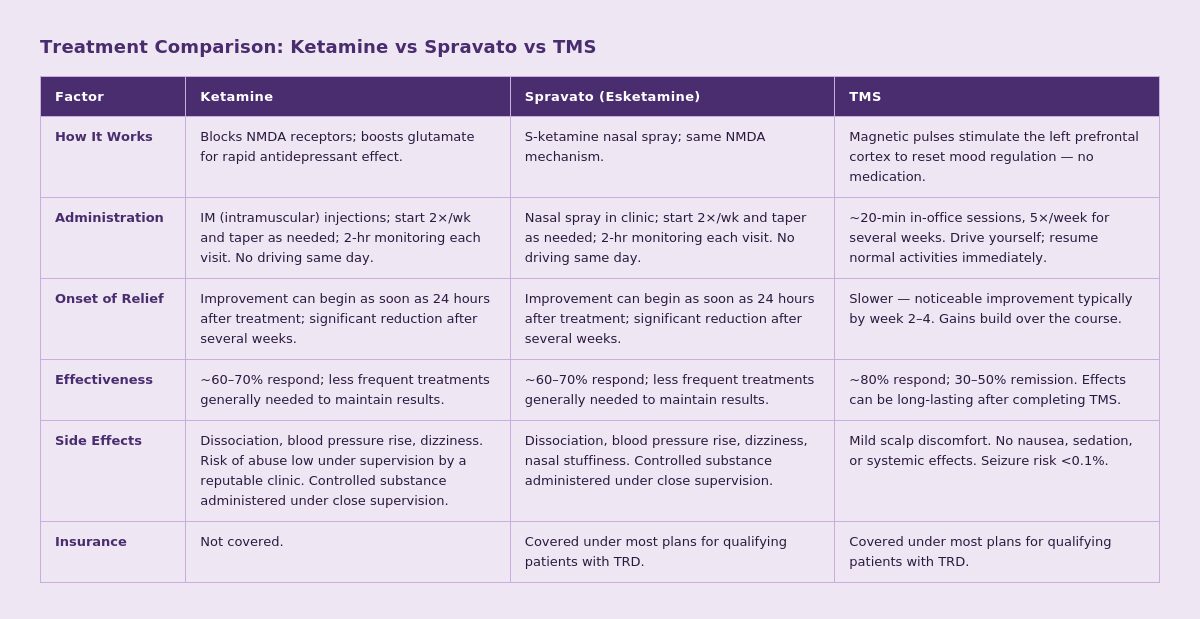
Below is a comparison table summarizing key differences in mechanism, administration, efficacy, side effects, and insurance for Ketamine, Spravato, and TMS:
Practical Considerations: Choosing the Right Treatment for You
Deciding between IV ketamine, Spravato, and TMS can feel overwhelming, but focusing on a few key considerations can help clarify the choice. Ask yourself:
- How urgent is relief needed? If you are in a crisis or have severe suicidal depression that needs rapid relief, ketamine or Spravato might be more appropriate to provide quick stabilization. TMS, while effective, takes a few weeks to kick in, so it’s less suitable if you need an immediate turnaround. Many patients start with ketamine/Spravato to get fast improvement, then transition into TMS or other long-term strategies.
- How do you feel about medications vs. devices? Ketamine and Spravato involve taking a mind-altering medication. Some people don’t mind the transient dissociative effects; others find them unpleasant or are nervous about mind-altering drugs. TMS involves a device and repeated office visits, but no systemic drugs – appealing to those who want to avoid medication side effects or have medical contraindications to ketamine (for instance, uncontrolled blood pressure or certain heart/eye conditions). If you prefer a non-pharmacological approach, TMS is the clear choice.
- Schedule and convenience: Consider what your schedule and responsibilities allow. TMS requires daily commitment on weekdays for several weeks, which can be challenging if you work full-time or live far from the clinic. However, each session is brief and you can drive yourself, possibly fitting it in before work or during lunch. Ketamine and Spravato are less frequent (typically 1-2 times per week initially), but you’ll spend about 2 hours at each appointment and will need someone to accompany or drive you due to post-treatment effects. If you have a flexible schedule or reliable transportation help, Spravato or ketamine sessions can be managed. If daily travel is hard, some patients still choose TMS because they can independently get to treatment and back. Athena Care will work with you to minimize disruption – for example, scheduling Spravato on days you have off, or arranging TMS at a convenient time of day.
- Tolerance of side effects: If the idea of dissociation or feeling loopy for an hour scares you, you might lean towards TMS, which has minimal side effects. If you’ve had trouble tolerating antidepressant side effects in the past, TMS is attractive for its clean side effect profile. Conversely, if you’re okay with a bit of an altered state during treatment and prioritize quick results, ketamine or Spravato could be acceptable. Many patients report that the dissociation with ketamine/esketamine is strange but not painful or terrifying, and some even find it therapeutic. Your care team will be there to talk you through the experience. Additionally, if you’ve struggled with medication adherence or consistency, TMS has the benefit of being provider-administered; once you show up, the treatment happens – no need to remember to take a drug regularly.
- Insurance and budget: As discussed, check your insurance coverage. If your insurance will cover TMS or Spravato nearly fully, those become financially attractive options. If you don’t have coverage for these and can afford out-of-pocket, ketamine infusion might actually be the cheapest short-term since you pay per infusion. Athena Care’s insurance verification can clarify what your plan covers. Don’t let sticker shock deter you without investigating your benefits – for many, Spravato or TMS ends up being very affordable with insurance, sometimes cheaper than multiple medication prescriptions over time.
- Long-term plan: Think about whether you want a treatment you can potentially do once and maintain results (TMS aims for a longer remission) or a treatment you’re okay continuing periodically (Spravato is often ongoing; ketamine often requires boosters). Some patients prefer TMS because they’d rather invest effort in a few weeks of treatment for a chance at feeling well for many months. Others don’t mind coming in weekly for Spravato if it keeps their depression in check. It’s a personal preference and also depends on how well each treatment works for you. It’s not uncommon to try one approach and later try another if needed. For instance, you might do TMS and get a good year of remission, but if depression returns, you could try Spravato at that point, or vice versa.
- Combining treatments: These therapies are not mutually exclusive. In fact, some patients undergo TMS and Spravato concurrently or alternate ketamine infusions with therapy sessions, etc., especially in severe cases. At Athena Care, our psychiatric specialists tailor treatment plans to each individual. After an evaluation, we might recommend one treatment or a combination. The beauty of having all options available is that we can use a multi-faceted approach if appropriate. Your provider will consider your medical history, depression severity, and personal preferences to develop a plan – whether that’s one modality or a sequenced strategy (for example, a few ketamine infusions to give immediate relief, then starting a TMS course for sustained improvement).
Remember: you are not alone in making this decision. Our team is here to answer your questions, share our clinical experience, and guide you toward the treatment that aligns best with your needs and goals.
Hope and Support at Athena Care
Choosing to pursue advanced depression treatment can be a big step, but it can also be a life-changing step toward reclaiming your life from depression. Many people who felt hopeless after trying “everything” have found significant relief through ketamine, Spravato, or TMS. These treatments represent cutting-edge advancements in mental health care – and importantly, they represent hope for those with treatment-resistant depression.
At Athena Care, we are proud to offer all three of these transformative treatments across our Tennessee clinics. Our approach is collaborative and patient-centered: we take the time to understand your unique situation and then help you navigate your options. If you’re unsure which treatment is right, you can start with a consultation where an Athena Care specialist will evaluate your depression history, answer all your questions, and recommend a personalized plan. There’s no one-size-fits-all answer – but there is an answer for you, and we’ll help you find it.
Our Tennessee community is at the heart of everything we do. Whether you visit us in Nashville, Memphis, Knoxville, or any of our locations, you’ll find a caring team ready to support you every step of the way. From handling insurance approvals to lending an ear during a tough day, we’ve got your back. Depression can be overcome, and you don’t have to struggle alone.
In the end, some patients find full remission with TMS and feel like themselves again; others might get relief from Spravato that allows them to enjoy life while continuing maintenance doses; others credit ketamine with pulling them out of a dark place when nothing else worked. Your journey is your own, but hope is on the horizon. Advances in science have given us more tools than ever to fight depression – and Athena Care is here to deliver those tools with expertise and compassion.
If you’re considering ketamine, Spravato, or TMS, we encourage you to reach out for a consultation. We’ll help you weigh the pros and cons as they apply to you personally. Our ultimate goal is to help you feel better and live a fulfilling life. With the right treatment plan, even treatment-resistant depression can enter remission. There is hope, and we’re here to help you seize it.
You deserve relief, and we at Athena Care are committed to helping you find the treatment that brings you healing and happiness. Reach out today, and take the next step toward a brighter tomorrow.
To learn more, please fill out this short contact form. You may also call or text 1-866-530-5226 or email [email protected].
If you or someone you love would benefit from talking to a mental health provider in Tennessee, call or text:
877-641-1155
One of our Care Coordinators will help you get the care you need.
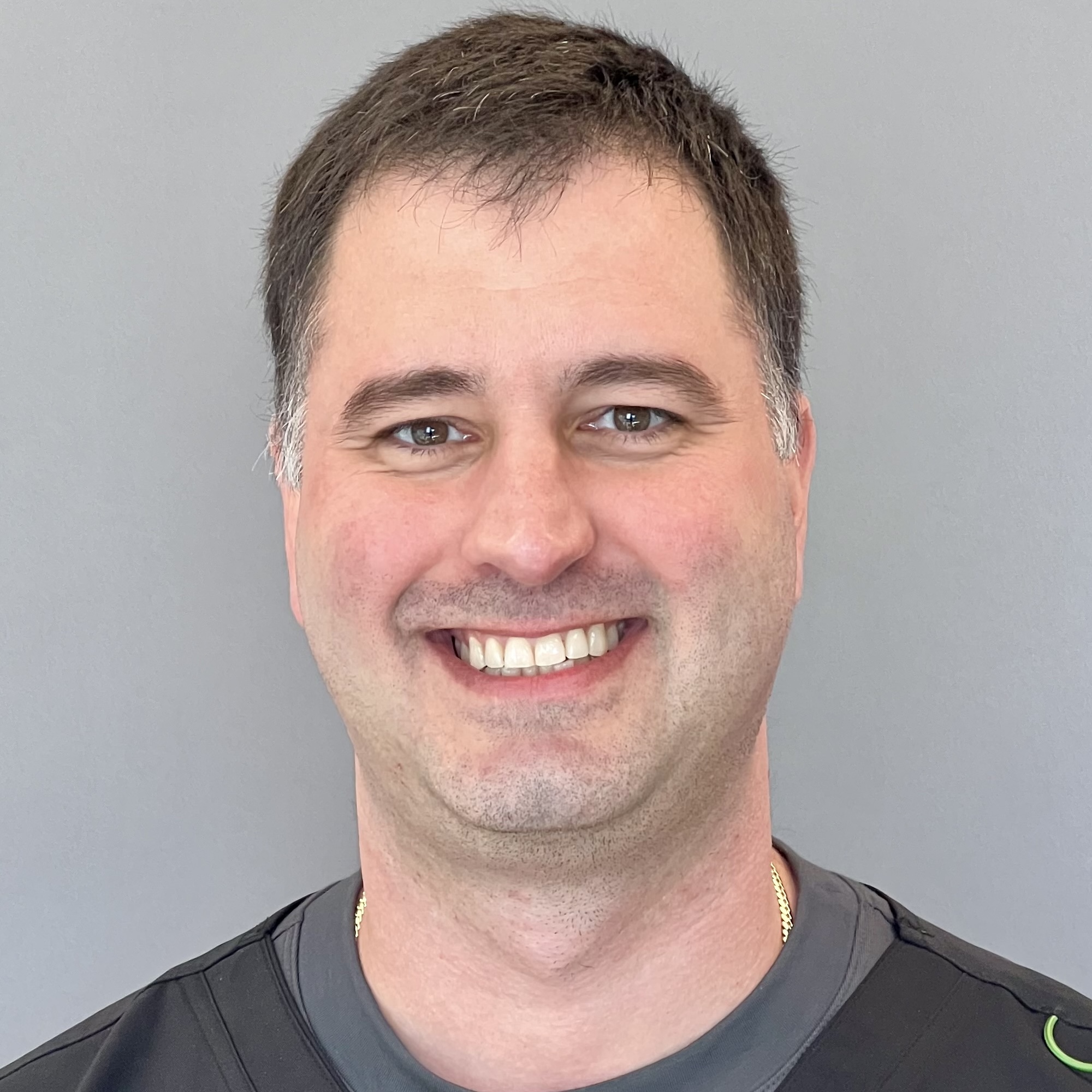
Justin Lapollo, DO
Psychiatrist
Dr. Lapollo specializes in offering full spectrum outpatient psychiatric treatment including psychiatric medication management, individual psychodynamic psychotherapy, Transcranial Magnetic Stimulation (TMS) mapping/treatment, and Ketamine treatment.

Meg Stein, CFP
Editor
Meg is a certified mindfulness instructor and works at Alive and Aware Practice in Durham, NC. She has over ten years of experience as a content creator and marketing consultant, working in mental healthcare and social justice.
Sources:
Athena Care – Spravato (Esketamine) Treatment Clinic in Tennessee. https://www.athenacare.health/services/interventional-psychiatry/spravato/
Athena Care – Ketamine for Depression. https://www.athenacare.health/services/ketamine-for-depression/
Athena Care – Transcranial Magnetic Stimulation (TMS). https://www.athenacare.health/services/interventional-psychiatry/tms/
GoodRx – Pardini, C. (2025). IV Ketamine vs. Spravato: Top 5 Differences for Hard-to-Treat Depression. https://www.goodrx.com/conditions/depression/iv-ketamine-vs-spravato
Breakthru Psychiatric Solutions – Giles, M. (2023). Ketamine, Spravato, or TMS: Pros and Cons of Each. https://www.breakthrupsych.com/post/ketamine-spravato-or-tms-the-pros-and-cons-of-each
McLean NTC – Ketamine vs. Spravato: Key Differences for Effective Treatment. https://mcleanntc.com/ketamine-vs-spravato/
Cognitive FX – Allen, M. (2025). Ketamine vs. TMS: Side Effects, Effectiveness & Costs. https://www.cognitivefxusa.com/blog/ketamine-vs-tms
UC San Diego Health – Pierce, A. (2025). Magnetic Stimulation Transforms Patient with Depression. (NIH stats on TMS). https://health.ucsd.edu/news/features/magnetic-stimulation-transforms-patient-with-depression/