


If you’ve tried antidepressants two or more times and still suffer from depression, you’re not alone, and you’re not out of options. TMS is a medication-free, FDA-cleared treatment that uses gentle magnetic pulses to reactivate the mood circuits depression quiets down [1], and Athena Care has delivered it at 220 Athens Way, Suite 104 in MetroCenter for years. It doesn’t require anesthesia or downtime after treatment. Here’s everything Nashville patients ask us, answered plainly.
You can schedule a free, 15-minute inquiry call to get started.
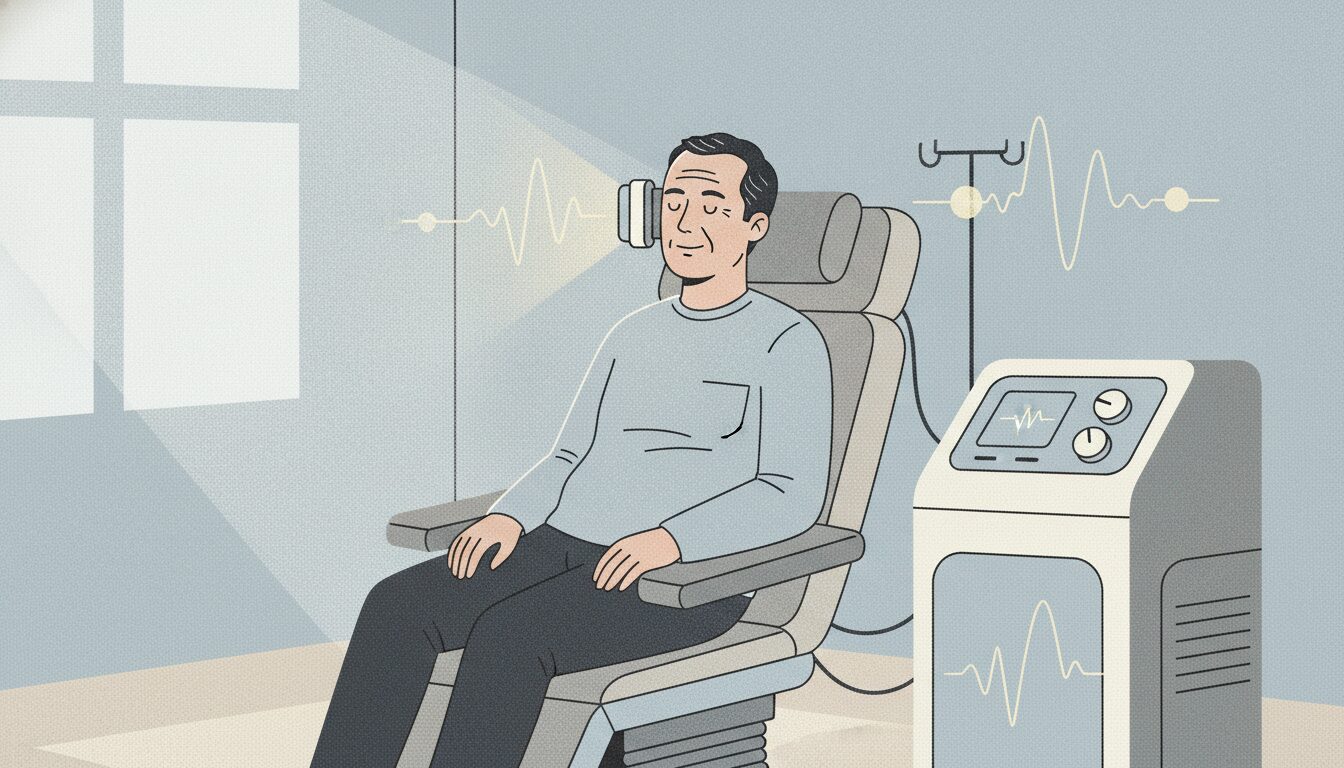
What is TMS?
Transcranial magnetic stimulation (TMS) is a non-invasive therapy for treating treatment-resistant depression (TRD) and other psychiatric and neurological conditions. It’s also beneficial in treating people with illnesses like anxiety, PTSD, OCD, addiction, ADHD, eating disorders, autism spectrum disorders, and chronic pain.
TMS is the first and only non-surgical, non-medication FDA-approved method for treating depression that is safe and effective. TMS in Nashville is typically used when other depression treatments, like medications and standard evidence-based therapy (psychotherapy), have failed.
Targeting particular areas of the patient’s brain, a trained provider places a tiny coil on the patient’s head that produces a quick alternating current. The magnetic fields created by the electrical current boost brain activation by flowing through the scalp and bone without causing any disruption. It activates parts of the brain that are less active when depressed.1
Your TMS provider must first decide where the magnets should be placed on your head and how much magnetic energy suits you. For the treatment of depression, a typical TMS treatment plan entails five sessions per week for a duration of 4-6 weeks.
Here’s what your initial appointment may look like:
- You’ll be led to a treatment area, instructed to sit in a recliner, and given earplugs to wear throughout the process.
- To produce stimulating pulses, your head will be pressed against an electromagnetic coil frequently turned on and off. As a result, a tapping or clicking sound is created, and it usually lasts just a moment before pausing. There will also be a tapping sensation on your forehead. This step in the process is referred to as mapping.
- To determine how much magnetic energy is required, your doctor will progressively raise the magnetic dose until your fingers or hands start to move. This is your motor threshold and is a benchmark for choosing the appropriate dose. Depending on your symptoms and side effects, the stimulation level can be adjusted throughout the treatment.
After TMS therapy, you can resume your regular daily routine.
Who provides your TMS care at MetroCenter
TMS at Athena Care is overseen by our psychiatrists, delivered session to session by trained TMS technicians, and reviewed weekly against your symptom scores. Your first visit runs about 90 minutes: a full history, a contraindication screen, and motor threshold mapping, which is how we calibrate the exact pulse strength your brain needs. If you want the deeper walkthrough first, our what to expect from TMS guide covers a full course start to finish. At our Nashville location, we use a MagVenture device for TMS treatment.
Fitting TMS treatment into your Nashville life
A full course is 5 short sessions a week for 4 to 6 weeks, and we’ve built the schedule around working people; In Nashville, we offer our first appointments at 8 am, along with lunchtime, late-afternoon and evening slots. The 20 to 40 minute sessions can fit before work or on a long lunch. There’s no sedation, so you drive yourself and go straight back to your day. And while large academic programs in town often quote waitlists of 2 to 4 months, our Care Coordinators can usually get your evaluation on the calendar within a week or two.
The results, in published numbers
In the largest real-world study of TMS in routine practice, 58% of people with treatment-resistant depression responded to a full course and 37% reached remission [2]. Roughly one in two to three of the hardest-to-treat cases getting meaningfully better, measured with standardized scores, is the honest version of the story. We track yours the same way, with a PHQ-9 at every stage, so progress is something you watch, not something you take on faith.
At Athena Care, we also track outcomes:
- 88% of Athena Care patients had a clinically meaningful improvement in depressive symptoms and 77% had a clinically substantial improvement
- 66% of Athena Care patients had at least a 50% reduction in symptoms (“responders”)
- 32% of Athena Care patients achieved remission (symptom-free)
- On average, patient depression scores improved by 57%.[6]
Cost and insurance in Nashville
Fortunately, most major plans cover TMS for depression once you’ve documented two adequate antidepressant trials plus a course of psychotherapy. We’re in network with Aetna, Ambetter, BlueCross BlueShield of Tennessee, Cigna, Medicare, and UnitedHealthcare, and our team pulls the records together and files the authorization for you, so the criteria are our paperwork problem, not yours. We also offer self-pay options and payment plans for those without insurance.
Meet our Chief Medical Officer
Athena Care’s Chief Medical Officer is the psychiatrist Dr. Amanda Sparks-Bushnell, M.D. She oversees Athena Care’s TMS program.

Dr. Amanda Sparks-Bushnell is a Board-Certified Psychiatrist who maintains a heartfelt commitment to transformative leadership and patient well-being. Her career is marked by a passion for enhancing medical services, fostering collaboration, and ensuring the utmost care for those she serves.
Get TMS With Athena Care in Nashville, Tennessee
Nashville TMS treatment is just a phone call away (615-320-1155) with Athena Care’s TMS clinic at 220 Athens Way, Suite 104, Nashville, Tennessee 37228. We are in-network with most major insurance companies, in addition to having a cutting-edge facility and highly educated TMS providers.
Our centers are open Monday through Friday, 7 am – 6 pm.
Find out more about our Nashville, TN Mental Health Clinic.
Frequently asked questions about TMS in Nashville
How long does TMS take, per session and overall?
Sessions run 20 to 40 minutes, 5 days a week for 4 to 6 weeks, 30 to 36 sessions in a typical course. First appointments start at 8am.
Can I drive and work right after?
Yes. No sedation, no downtime. Some patients come before their workday begins.
Does TMS hurt?
It feels like rhythmic tapping with a clicking sound. Early-session scalp tenderness or a mild headache usually fades within the first week [3].
What does TMS cost in Nashville with insurance?
With coverage, most people pay a specialist copay per session. We also offer self-pay options and payment plans for those without insurance. We verify your exact benefits before you start.
What does TMS cost in Nashville with insurance?
No. ECT uses electrical currents under anesthesia; TMS uses magnetic pulses while you’re fully awake, with no memory side effects and no recovery time [3].
What if TMS isn’t enough?
The same clinic offers Spravato, medication care and therapy, so your next option is a conversation with the team that already knows your history.
And if you’re in crisis right now, don’t wait for an appointment: call or text 988, the Suicide & Crisis Lifeline answers 24/7.
Contact us today
Visit Us
Address
220 Athens Way
Suite 104
Nashville, TN 37228
Phone: (877) 641-1155
Fax: (615) 320-1177
Hours
M-F 7:00am – 6:00pm
Languages
English
[1] Psychiatric News, FDA Approves New Option to Treat Major Depression (Nov. 2008): https://psychiatryonline.org/doi/10.1176/pn.43.22.0002
[2] Carpenter, L. L., et al., Transcranial Magnetic Stimulation (TMS) for Major Depression: A Multisite, Naturalistic, Observational Study of Acute Treatment Outcomes in Clinical Practice, Depression and Anxiety, 29(7): 587-596 (Jul. 2012): https://onlinelibrary.wiley.com/doi/10.1002/da.21969
[3] Mayo Clinic, Transcranial Magnetic Stimulation, including FDA approval status and risks (Apr. 2023): https://www.mayoclinic.org/tests-procedures/transcranial-magnetic-stimulation/about/pac-20384625
[4] Blumberger, D. M., et al., Effectiveness of Theta Burst Versus High-Frequency Repetitive Transcranial Magnetic Stimulation in Patients With Depression (THREE-D): A Randomised Non-Inferiority Trial, The Lancet, 391(10131): 1683-1692 (Apr. 2018): https://doi.org/10.1016/S0140-6736(18)30295-2
[5] Cole, E. J., et al., Stanford Neuromodulation Therapy (SNT): A Double-Blind Randomized Controlled Trial, American Journal of Psychiatry, 179(2): 132-141 (Feb. 2022): https://doi.org/10.1176/appi.ajp.2021.20101429
[6] Athena Care, internal TMS outcomes data (as of Oct. 2026): based on 82 patients treated with TMS in the last 3 years who received a minimum of 30 treatments and had at least 3 PHQ-9 scores recorded during treatment.
[i] Based on 82 patients treated with TMS in the last 3 years receiving a minimum of 30 treatments and having at least 3 PHQ-9 scores during treatment.