

It’s often the first question: “How long is this going to take?” People ask it about the death of a parent or spouse, the loss of a beloved dog or cat, the end of a marriage. Underneath the question is a hope that grief has a due date — that if they can just hold on until some marker, they’ll wake up and feel finished.
“No two people grieve the same, and there are many different forms of grief. These may include the loss of a loved one, the death of a pet, miscarriage or pregnancy loss, the end of a significant relationship, and complicated grief, among others.” Athena Care therapist, Extasy Grinn, LCSW talks about the theory of grief that she uses in her therapeautic practice and offers a few practical tips for how to move with grief.
What the research shows
“Grief does not have a timeline,” says Extasy. “Each person processes grief in their own unique way, and it is important to consider an individual’s culture, values, and belief system when understanding their grief experience.”
Grief has no fixed expiration date, but it does change, and for most people it becomes far more livable than it feels right now. It’s a process, not a permanent state, and most people move through the sharpest phase without needing treatment.
A 2025 review in the National Library of Medicine’s StatPearls notes that most adults adequately process acute grief within about a year — meaning they can function and move forward, not that they’ve forgotten the person. Roughly 7% develop prolonged grief disorder, where intense symptoms persist and daily life stays impaired past a year. That’s real and treatable, but it isn’t the norm.
A large 2025 Danish study in Frontiers in Public Health followed more than 1,700 bereaved people for a decade and found five different grief “trajectories.” The largest group — 38% — carried consistently low levels of grief symptoms throughout, and only 6% stayed persistently high. In other words, most people are more resilient than they expect to be. That doesn’t make your pain less valid; it means the odds are genuinely in your favor.
Grief doesn’t end — it transforms
The old idea that healthy grieving means “letting go” and “moving on” has largely been retired. In 1996, researchers Dennis Klass, Phyllis Silverman, and Steven Nickman introduced Continuing Bonds Theory, which reframed grief entirely. Their finding: healthy mourners don’t sever the connection to who they lost. They keep it, in a new form — talking to the person, carrying their values, marking anniversaries, keeping a small object close.
“This approach recognizes that while the physical presence of a person or pet may be gone, the relationship itself does not necessarily end.” Extasy says, “We carry our loved ones with us through our memories, values, stories, and the impact they had on our lives. In that sense, they continue to live on in our hearts and minds.”
Recent work supports this. A 2025 paper in Death Studies by Zeynep Selvili and Klass himself describes continuing bonds not as a consolation prize for a relationship you can’t have, but as an evolving extension of the relationship you always had. A 2025 study of bereaved parents found that the benefit of those bonds depends largely on how you weave the memory into daily life — connection that adds meaning rather than keeping you stuck.
This applies to pets, too. A 2024 study in Death Studies confirmed what pet owners already know: grief for a companion animal can be severe and genuine, shaped by how attached you were and how you maintain the bond afterward. And while the end of a relationship isn’t a death, the same principles hold — you’re mourning a real attachment and a future you expected, and you’re allowed to.
“No one can pressure us to move on, including ourselves,” says Extasy. “Rather than letting go of the relationship we learn how to stay connected to the relationship in a different form/way.”
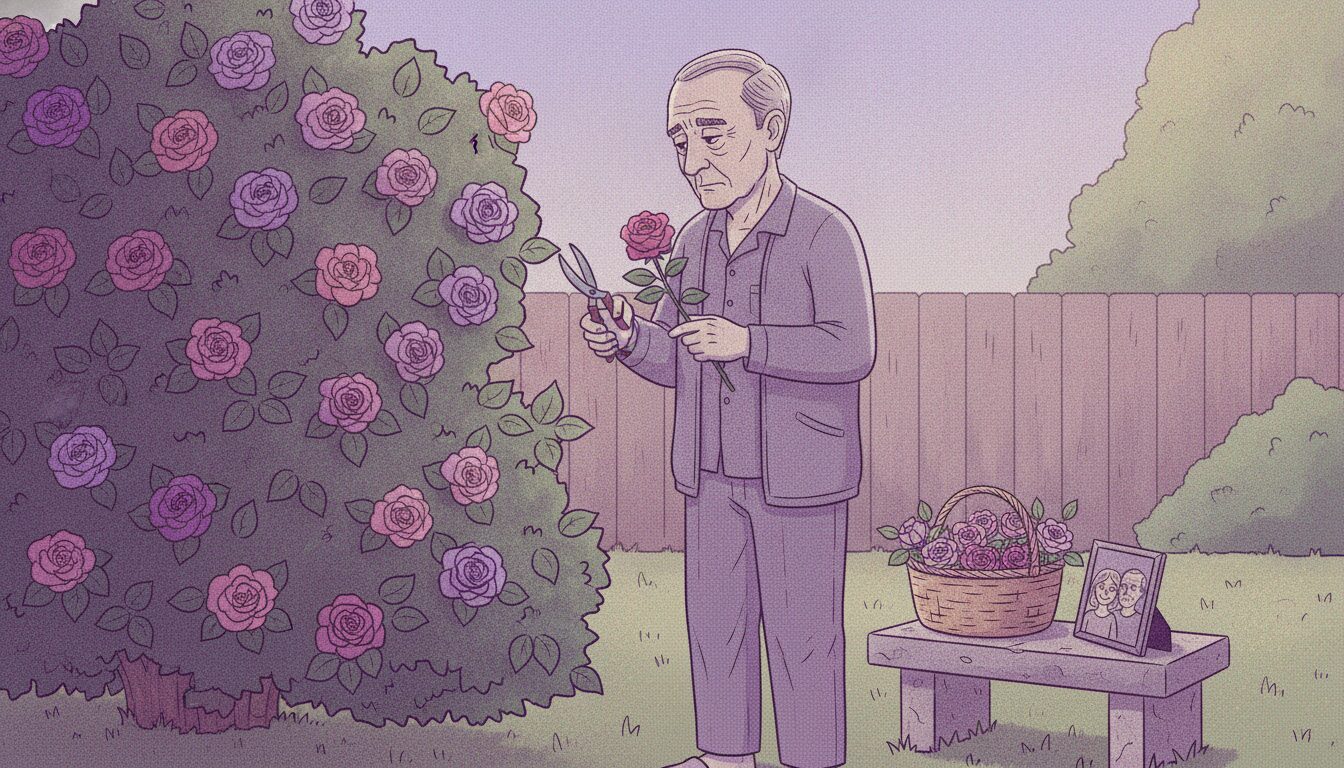
Some things that help
Grief usually moves in waves, not a straight line, and it often surges around birthdays, holidays, and familiar songs or smells. That’s not regression; it’s the sign of a bond that mattered. With that in mind:
- Let grief come in and out. You don’t have to feel it every minute. It’s healthy to move between leaning into the pain and stepping back into ordinary life — work, errands, laughter. Both are part of healing.
- Keep the bond, on purpose. Write a letter, cook their recipe, keep a photo where you’ll see it, or do something the person or pet would have loved. “Rather than letting go of the relationship entirely, the goal becomes finding a new way to maintain that bond while adapting to life after the loss,” says Extasy. This isn’t clinging; it’s integration.
- Honor and remember. Extasy shares that, “Many people find comfort in creating traditions, rituals, or meaningful ways to honor and remember those they have lost, allowing the connection to remain present even after death.”
- Say it out loud to someone. Support doesn’t speed grief up, but it lets you suffer less alone. Name your loss to a friend, a group, or a therapist.
- Plan for the calendar. Anniversaries hit hard. Choose something gentle for those days rather than being ambushed by them.
When to reach out
If, past a year or so, grief is still keeping you from functioning — you can’t work, sleep, or engage with people, or you’re leaning on substances to cope — that’s worth raising with a professional. Prolonged grief responds well to treatment, and asking for help is a sign of strength, not failure.
However long your process takes, hold on to this: the goal was never to stop loving them. It’s to carry that love in a way you can live with. Most people, in time, do exactly that.
If any of the above resonated with you or someone you love, reach out to Athena Care so we can help. You can contact us by filling out this short form or call/text us at +1 877-641-1155 or email [email protected].
Contact us today

Extasy Grinn, LCSW
Therapist
Extasy is a Licensed Clinical Social Worker and provides individual therapy to adults. She has training and expertise in a variety of mental and behavioral health areas, including addiction treatment, geriatric care, child therapy and individual therapy with adults.

Meg Stein, CFP
Editor
Meg is a certified mindfulness instructor and works at Alive and Aware Practice in Durham, NC. She has over ten years of experience as a content creator and marketing consultant, working in mental healthcare and social justice.
Sources:
Schoo C, Azhar Y, Mughal S, et al. Grief and Prolonged Grief Disorder. StatPearls, National Library of Medicine (updated 2025).
Nielsen MK, et al. Persistent, intense grief and ten-year mortality and healthcare use. Frontiers in Public Health (2025).
Selvili ZZ, Klass D. Continuing bonds or ongoing attachments? Exploring the distinction. Death Studies (2025).
Lykins AD, McGreevy PD, Bennett B, et al. Attachment styles, continuing bonds, and grief following companion animal death. Death Studies (2024).
Kim et al. Continuing bonds, complicated grief, and posttraumatic growth among bereaved parents. Death, Grief and Bereavement / ScienceDirect (2025).