

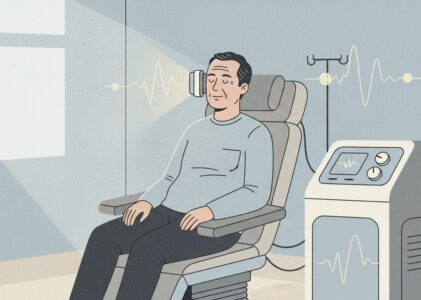
If you’ve done the research, talked to your psychiatrist, and decided that TMS is the right next step for your depression, you don’t need another general explainer.
You need practical answers to practical questions: which Athena Care locations actually have TMS, where they are, what the first visit involves, who runs the treatments, and how the daily schedule fits into a real work week. This page covers all of that.
Where Athena Care offers TMS in Middle Tennessee
Our Nashville TMS program operates out of our Nashville location at 220 Athens Way, Suite 104, Nashville, TN 37228. The location is just off I-65 and minutes from Downtown, MetroCenter, and West Nashville neighborhoods. On-site parking is available. The Nashville office offers the full scope of interventional psychiatry services, including TMS, Spravato, and Ketamine.
We also offer TMS at our locations in Murfreesboro, Franklin, Knoxville and Clarksville. Learn more on our Locations page.
Who runs the treatments
Our Nashville TMS team operates under the oversight of our interventional psychiatry team, which includes psychiatrists with specific TMS training and certification. The day-to-day treatment delivery is handled by trained TMS technicians under medical supervision, with a psychiatrist available throughout and overseeing your treatment course.
You can reach our TMS team directly at 615-861-1000 or via email at [email protected] for clinical questions. For scheduling and benefits verification, our main care coordinator line is 877-641-1155.
What the first visit looks like
The initial TMS evaluation is a longer, more comprehensive visit than a typical psychiatry appointment. Plan for about 90 minutes for the first visit, which usually includes:
- A comprehensive psychiatric evaluation to confirm your diagnosis, review your treatment history (medications tried, prior therapy, prior interventional treatments), and document the medical necessity required for insurance approval
- A medical screening specifically for TMS, focused on the contraindications (ferromagnetic implants in the head, seizure history, neurological conditions, certain medications that lower seizure threshold). This screening determines whether you can safely receive TMS.
- Motor threshold determination at your first treatment session, this is the calibration step where the psychiatrist identifies the magnetic intensity needed for your specific anatomy. Most people do this at the start of their first treatment session rather than as a separate appointment.
- A treatment plan discussion, including expected course length (typically 30 to 36 sessions over 4 to 6 weeks), what to expect day to day, and how progress will be measured
If you’ve already completed evaluation with your referring psychiatrist, the visit may be shorter; if you’re brand new to interventional psychiatry, expect closer to the full 90 minutes.
Our medication management philosophy
This is the section many Williamson County families want to read carefully before booking. Here’s how we approach pediatric psychiatry:
Conservative. We do not believe in starting medication without diagnostic clarity. For ADHD, that often means comprehensive psychological testing first to rule out anxiety, depression, sleep issues, or learning disabilities that can mimic ADHD. For mood disorders, particularly any consideration of bipolar in a child, testing and a careful diagnostic process precede medication decisions.
Family-involved throughout. Parents are part of every step: the initial evaluation, the medication discussion, ongoing follow-ups, and any changes to the treatment plan. We don’t dose children behind closed doors. You’ll understand what’s being prescribed, why, what side effects to watch for, and how to know if it’s working.
Second opinions welcome. If you’re seeing us for a second opinion on a current medication regimen, or you want to discuss whether to discontinue a medication your child has been on, that’s a legitimate reason to schedule a consultation. We don’t view second-opinion seekers as difficult patients; we view them as engaged parents.
Therapy-first when appropriate. For mild-to-moderate anxiety or depression in kids, evidence-based therapy (CBT in particular) often produces meaningful improvement without medication. We’ll tell you when that’s the appropriate first step, and our integrated team can provide both therapy and medication management when the right plan calls for both.
Tracked outcomes. We use validated rating scales appropriate to the condition (Vanderbilt rating scales for ADHD, PHQ-A for depression, SCARED for anxiety) to track whether the treatment is actually working, not just whether your child says they feel “fine.”

The practical questions that actually matter
This is the section the brief is built around: the workweek-feasibility questions that many Nashville patients ask about.
Can I drive home after a session?
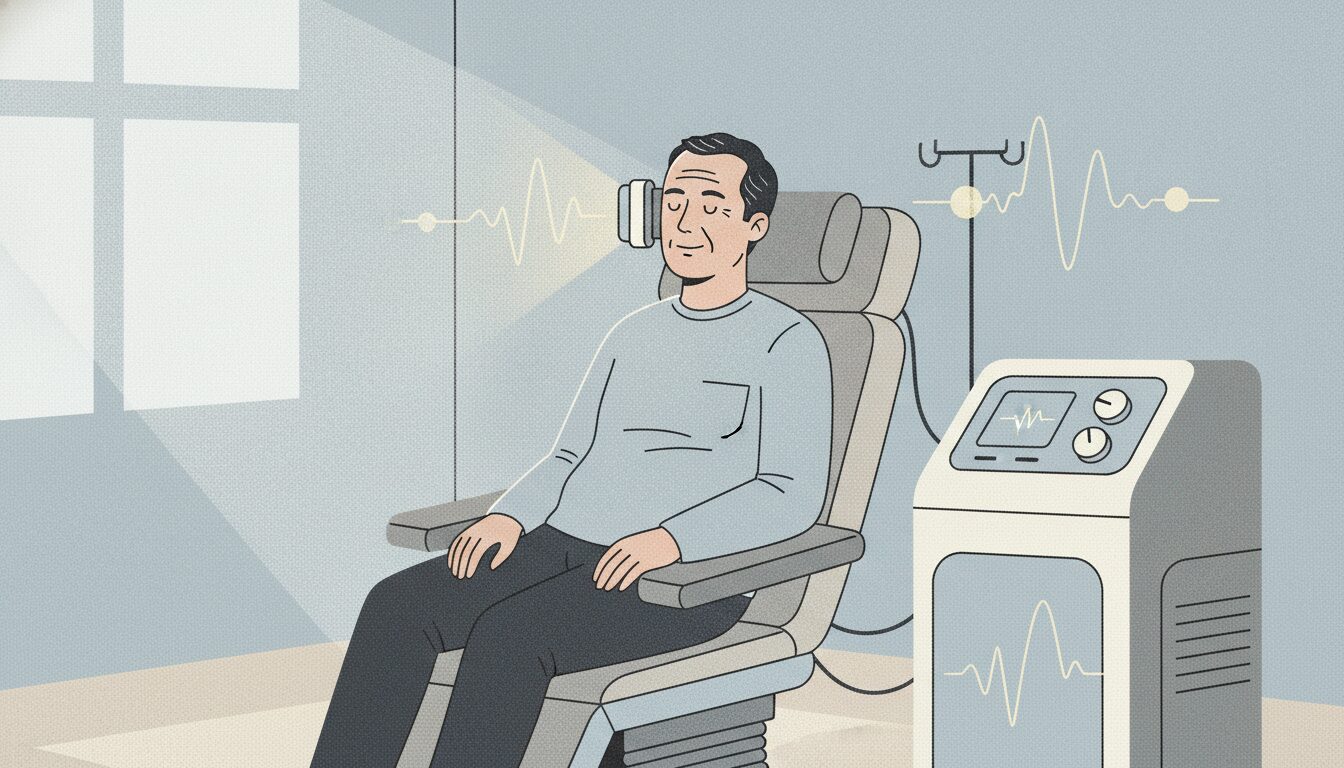
Yes. TMS doesn’t involve sedation, anesthesia, or medication. You can drive yourself to your appointment, sit in the chair fully awake, watch TV or read on your phone during the 20-to-40-minute session, and drive yourself back to work or home immediately after.
A small number of patients feel briefly foggy for 15 to 30 minutes after the first few sessions, similar to the lightheadedness after getting up too fast. If you do, you can sit in the waiting area for a few minutes before driving. After the first week, most patients don’t notice this at all.
How do I fit 30 to 36 sessions into a workweek?
A typical course of TMS for depression is 5 days per week for 4 to 6 weeks. We schedule TMS treatments before or after work hours, with early morning slots (often starting at 7:30 AM) and late afternoon to early evening slots available so patients can fit treatment around a normal 9-to-5 work schedule.
With session times of 20 to 40 minutes plus a few minutes for setup and check-in, a TMS appointment occupies about 30 to 45 minutes of your day. Most working patients schedule TMS as either a before-work or after-work appointment, similar to how they’d schedule physical therapy. For patients with more flexibility (remote work, shift work, retirement, family caregiving), lunchtime or mid-day slots are available.
We do not require you to take time off work or significantly disrupt your routine for a course of TMS.
What if Vanderbilt or another local provider has a long waitlist?
Middle Tennessee TMS capacity is genuinely limited, and Vanderbilt’s interventional psychiatry program is well-known to carry meaningful waitlists, sometimes 2 to 4 months or longer. If your psychiatrist has referred you to Vanderbilt or another provider and you’ve been told you’ll be waiting through the summer or longer, we often have shorter wait times for new TMS patients.
Our intake process for new TMS patients usually moves through:
- Initial phone screening with our care coordinator
- Insurance verification and prior authorization (1 to 2 weeks)
- Psychiatric evaluation
- Treatment start
The bottleneck is usually insurance prior authorization, not our scheduling capacity. Once authorization is approved, we can usually start treatment within a week or two.
Insurance accepted for TMS
TMS for treatment-resistant depression is covered by most major insurance plans in Tennessee, including:
- BlueCross BlueShield of Tennessee
- Cigna
- Aetna
- UnitedHealthcare
- Humana
- Medicare (Part B)
Coverage requires documented medical necessity, including failure of an adequate trial of at least 2 to 4 antidepressant medications and a course of psychotherapy. Our care coordinator handles the prior authorization process as part of intake.
What our patients ask
A few practical things that come up often:
- What happens if I miss a day? Occasional missed sessions are usually fine and we can extend the course slightly. We try to keep gaps under 2 to 3 days when possible to maintain the treatment’s neural impact.
- Can I keep taking my current antidepressant? Usually yes. Most patients continue their existing medication during the TMS course; some adjust during or after based on response.
- How will I know if it’s working? We track response using standardized depression scales (PHQ-9) at intake and throughout the course. Most patients who respond start noticing improvement around week 3 to 4, sometimes earlier.
- What’s the average response rate? Roughly 50 to 60 percent of patients with treatment-resistant depression respond to TMS, and roughly a third achieve remission, per the published clinical data.
For more on what TMS feels like, our article TMS for depression: what to expect go into more detail.
More frequently asked questions
Where in Nashville is Athena Care’s TMS clinic? 220 Athens Way, Suite 104, Nashville, TN 37228. The location is just off I-65 with on-site parking.
Can I drive home after a TMS session? Yes. TMS doesn’t involve sedation or anesthesia. Most patients drive themselves to and from sessions and continue their normal day immediately after.
What hours do you offer TMS? We offer early morning and late afternoon/early evening slots specifically so patients can fit TMS around a work schedule. Specific times depend on the week and our team’s capacity.
How long is the wait to start TMS? After your initial call, the timeline is usually 1 to 2 weeks for insurance prior authorization, then your psychiatric evaluation, then treatment start, often within a few weeks total. Wait times tend to be shorter than at larger hospital-based programs.
What insurance plans cover TMS? Most major commercial insurance plans (BCBST, Cigna, Aetna, UHC, Humana) and Medicare cover TMS for treatment-resistant depression with documented medical necessity. Our care coordinator verifies your specific benefits.
Do I have to stop my current medications? Usually no. Most patients continue their existing antidepressant medication during TMS treatment. The psychiatrist will review your medication list during your evaluation.
Who runs the treatments? Trained TMS technicians deliver the day-to-day treatments under the medical supervision of our interventional psychiatry team, with a psychiatrist overseeing your course and available throughout.
Can I reach the TMS team directly? Yes. Our TMS team can be reached at 615-861-1000 or [email protected] for clinical questions specific to your treatment.
How to book
Two ways to start:
Call our care coordinator at 877-641-1155, Monday through Friday, 7am to 6pm. They handle scheduling, benefits verification, and matching you with the right TMS team member.
Or contact our TMS team directly at 615-861-1000 or [email protected] for clinical questions specific to your treatment.
You can also schedule online through our appointments page if you’d prefer to start that way or fill out the contact form below.
For more on our broader TMS program, see our TMS service page.
Contact us today
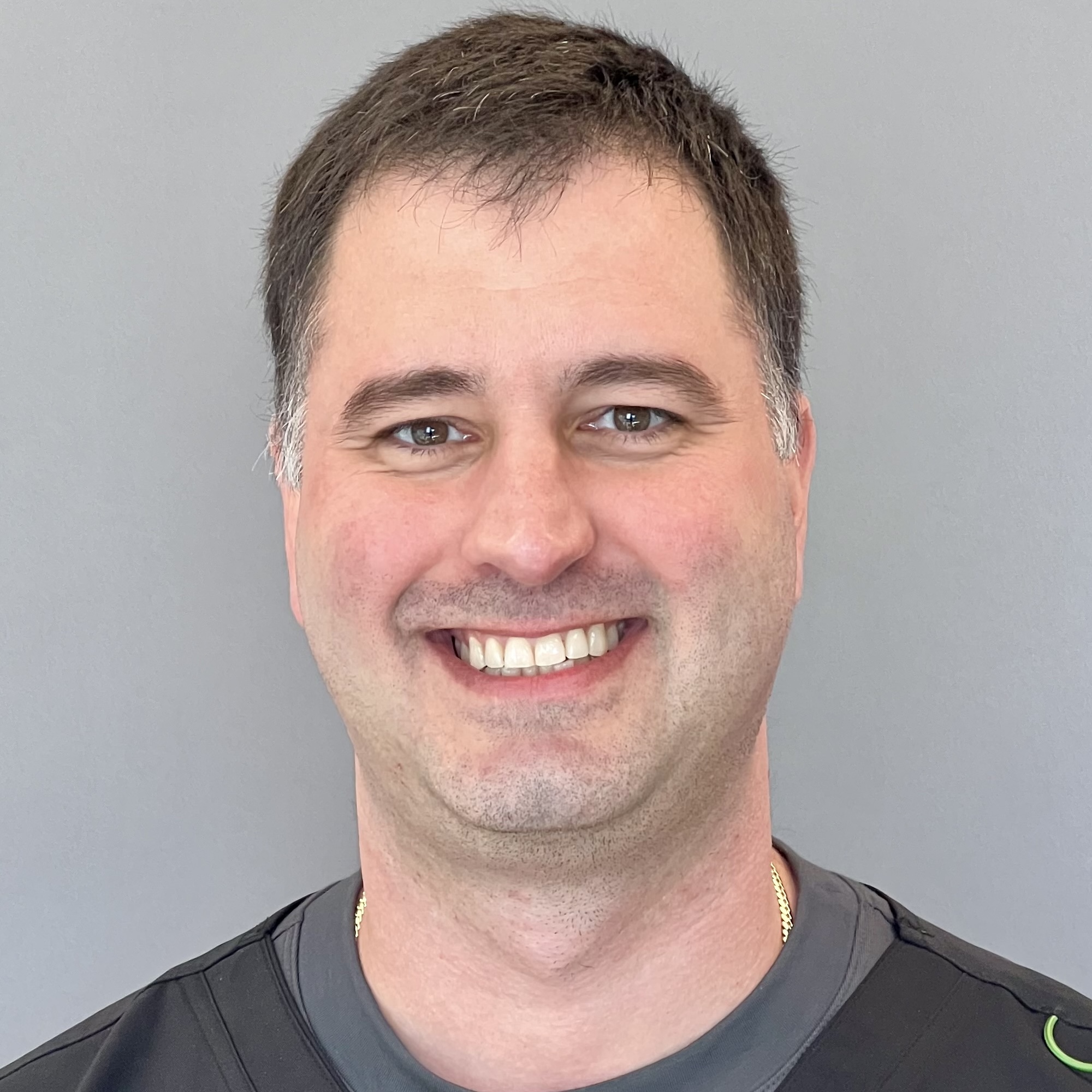
Justin Lapollo, DO
Psychiatrist
Dr. Lapollo specializes in offering full spectrum outpatient psychiatric treatment including psychiatric medication management, individual psychodynamic psychotherapy, Transcranial Magnetic Stimulation (TMS) mapping/treatment, and Ketamine treatment.

Meg Stein, CFP
Editor
Meg is a certified mindfulness instructor and works at Alive and Aware Practice in Durham, NC. She has over ten years of experience as a content creator and marketing consultant, working in mental healthcare and social justice.