

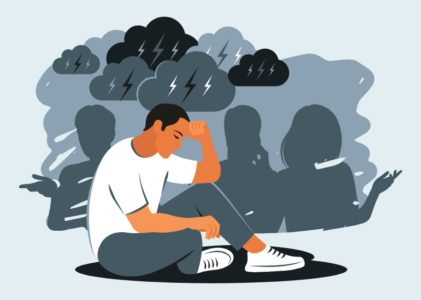
If you’ve ever sat with that quiet ache of wanting more connection — real connection — you’re not alone, and you’re not broken. Making friends as an adult is genuinely hard. But it’s also entirely possible, and the fact that you want it is already half the battle.
Athena Care therapist, Extasy Grinn, LCSW shares the honest truth about adult friendship and offers practical tips.
Jump to a loneliness quiz

Why Adult Friendship Is So Hard
The struggle is real, and the data backs it up. While 75% of Americans are satisfied with the number of friends they have, only 56% are happy with the time they spend with friends — and 40% long for greater closeness. More tellingly, 51% of Americans say it’s difficult to make new friends, and 62% say it was easier at another point in their life. No matter what age group was surveyed, people consistently felt that friendship used to come more naturally.
Why? Because it did.
As children, friendship happened almost automatically — you were surrounded by peers in repeated, unstructured settings (school, the neighborhood, sports teams) with plenty of time and low social stakes. Extasy explains that, “When we are adults we don’t have the same social structures that we do in high school or college. We have responsibilities with family and work and sometimes can be exhausted.”
Sociologists describe the conditions needed for organic friendship as continuous unplanned interaction plus shared vulnerability. Adult life quietly dismantles both. Work, commutes, caregiving, and screens carve up our days. We’re more guarded. We move cities. We stop bumping into the same people over and over.
A survey of more than 6,200 U.S. adults found that about one in six Americans feel lonely or isolated most of the time — with younger adults (under 50) reporting loneliness more frequently than older ones. That’s a striking inversion of what many people expect. It turns out that being digitally connected and being meaningfully connected are not the same thing.
There’s also a psychological layer: as adults, we tend to wait to be chosen rather than choose. We assume that if someone wanted to be our friend, they’d reach out. They’re thinking the same thing about us.
What You Can Actually Do About It
Here’s where it gets encouraging. The research on adult friendship points clearly toward what works.
1. Prioritize repetition over chemistry. The biggest myth about friendship is that it’s about finding the right person. It’s really about finding the right rhythm. Research suggests it takes roughly 200 hours of time together to develop a close friendship — but you don’t need to schedule 200-hour marathons. What you need is recurrence. “Transitioning from acquaintances to meaningful relationships can take time, and that is okay,” says Extasy.
A weekly running group, a standing dinner, a pottery class, a book club. The specific activity matters far less than showing up to the same place, with the same people, over time. Behavioral evidence builds trust faster than any single deep conversation.

2. Be the one who initiates — consistently. Most adults are waiting for someone else to make the first move. People consistently wish their friends would reach out more, while their friends are wishing the exact same thing. Break the logjam. Text first. Suggest the plan. Don’t wait to feel ready, because that feeling rarely comes.
3. Let yourself be seen. Small talk is a necessary gateway, but it’s not the destination. Research on adult friendship consistently shows that genuine closeness forms when people share something real — a struggle, a fear, a hope — rather than curated highlights. This doesn’t mean oversharing with strangers. It means being willing to say “honestly, things have been a little hard lately” when someone asks how you’re doing. Vulnerability invites reciprocity. It signals safety.
4. Lower the bar for what counts as “potential friend. “Friendships are about creating relationships that fill our cup up, but these bonds do not have to be our ‘best friends’ right away,” says Extasy. We become pickier as adults, often without realizing it. Adults long for more closeness with existing friends rather than entirely new people. Start there. Who in your life do you already like but have let drift? A colleague you always enjoy but never see outside work? A neighbor you wave to but don’t really know? The foundation may already be there.
5. Treat friendship like a commitment, not a luxury. One of the most consistent findings in recent friendship research is that adults who maintain strong social ties treat them as a scheduled, non-negotiable part of life — the same way they treat exercise or doctor’s appointments. It sounds unromantic, but it works. A standing “Wednesday night” tradition, even if it’s just a phone call, builds more lasting connection than waiting for the stars to align.
“We do not have to put pressure on ourselves to have these immediate bonds, and we can start slow,” says Extasy. “We can have regular connection times, like coffee dates, and slowly build new relationships over time.”
One Final Thought
The loneliness many adults feel is not a personal failing. It’s a structural one — a reflection of how modern life is built, not who you are. Time spent alone has risen for nearly all Americans over the past two decades. This is a shared cultural moment, not a private one.
That means the solution is also shared. Reach out to someone this week — not because you feel ready, but because they’re probably hoping you will.
If any of the above resonated with you, reach out to Athena Care to understand learn how we can help you. You can contact us by filling out this short form or call/text us at +1 877-641-1155 or email [email protected].
Take the loneliness quiz

Extasy Grinn, LCSW
Therapist
Extasy is a Licensed Clinical Social Worker and provides individual therapy to adults. She has training and expertise in a variety of mental and behavioral health areas, including addiction treatment, geriatric care, child therapy and individual therapy with adults.

Meg Stein, CFP
Editor
Meg is a certified mindfulness instructor and works at Alive and Aware Practice in Durham, NC. She has over ten years of experience as a content creator and marketing consultant, working in mental healthcare and social justice.
Sources:
Pennington, N., Hall, J., & Holmstrom, A. (2024). The American Friendship Project: A report on the status and health of friendship in America. PLOS ONE. https://journals.plos.org/plosone/article?id=10.1371/journal.pone.0305834
Pew Research Center. (2025, January). Men, Women and Social Connections. https://www.pewresearch.org/social-trends/2025/01/16/men-women-and-social-connections/
Colorado State University / American Friendship Project. (2024). Are we in a loneliness epidemic? Study shows Americans don’t need more friends — just more time with those they have. https://libarts.source.colostate.edu/are-americans-suffering-a-friendship-crisis-study-shows-we-dont-need-more-friends-just-more-time-with-those-we-already-have/
American Institute for Boys and Men. (2025). Male loneliness and isolation: What the data shows. https://aibm.org/research/male-loneliness-and-isolation-what-the-data-shows/
Franco, M. (2024, July). Why making new friends as an adult is so hard. Psychology Today. https://www.psychologytoday.com/us/blog/i-hear-you/202507/why-making-new-friends-as-an-adult-is-so-hard