

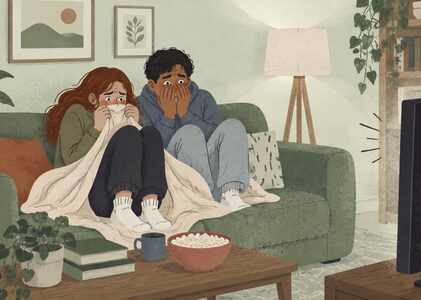
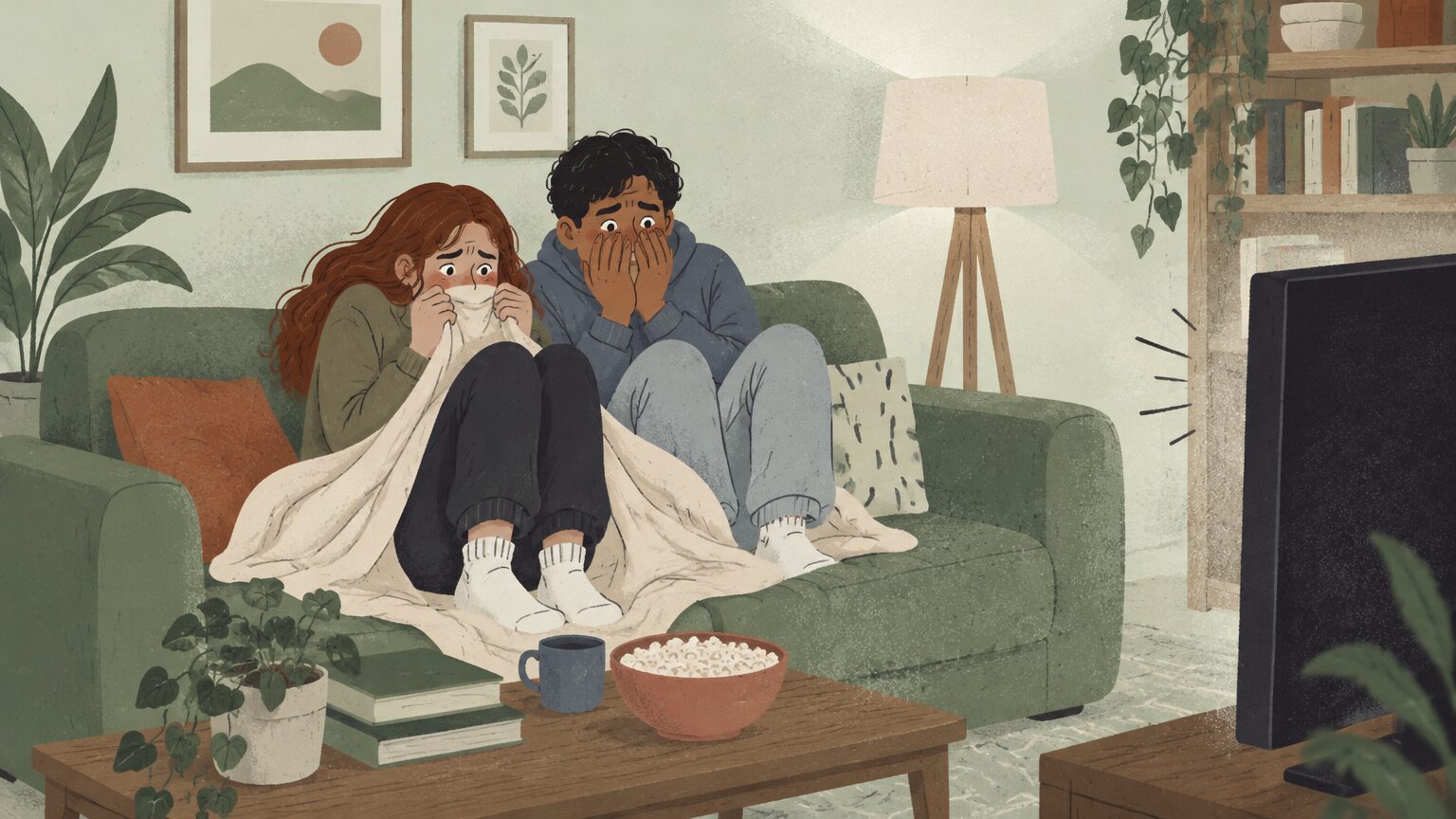
Every October, plenty of anxious people voluntarily sit in the dark and let a movie scare them.
The idea that this might be good for us is appealing. Athena Care psychiatrist Dr. Tim Bilbruck, M.D. shares more about how the science is more interesting, and more mixed, than the headlines suggest.
Wondering if you have anxiety? Jump to a confidential self- assessment.
What fear does in your brain
When you learn that something scary is actually safe, a region called the ventromedial prefrontal cortex (vmPFC) quiets the amygdala, your brain’s alarm system. This is fear extinction, and it’s the engine behind exposure therapy, one of the best-supported treatments for anxiety.
Some research suggests the circuitry doesn’t need real-world danger to switch on. A 2018 Neuron study found that imagining a feared situation engaged the same vmPFC-amygdala network as actually facing it. Horror films also light up the brain: a 2010 Human Brain Mapping study found that threatening movie scenes activate fear-related regions, and that people high in sensation-seeking appear to need stronger stimulation to feel the same engagement, which may be why they crave scary stories.
So the overlap is real. A horror movie can get your fear circuitry working, and that’s the promising part.
Why a movie isn’t exposure therapy
Here’s the catch. Therapeutic exposure works because the feared outcome doesn’t happen. You face the thing, the disaster never arrives, and your brain updates. Horror films are built to do the opposite. The monster appears. The jump scare lands. That may reinforce fear rather than erase it.
Other ingredients are also missing from a casual movie night:
- Safety learning. Therapy explicitly teaches your brain that a cue is safe in a particular context. A film rarely frames things that way.
- A graduated plan. Clinicians build a step-by-step hierarchy. Most of us just pick whatever’s on streaming.
- Cognitive processing. Talking through what happened and what you learned is part of the work.
There’s also a hint that effects may stay shallow. A 2022 study on stimulating the vmPFC after exposure found it reduced the return of physiological fear responses but not people’s conscious expectation of threat. By analogy, a scary movie might calm your body’s reaction without changing what you believe about the thing you fear. That’s an inference, not a finding, and no robust trial has tested horror films as treatment.
What it might still offer
A few benefits remain plausible, even if unproven:
- Mastery. You choose the film and the moment to look away. Control is a recognized ingredient in exposure’s success, and it’s the opposite of an intrusive memory.
- Relief as reward. A 2024 review in the Journal of Anxiety Disorders highlights how reward and relief signals contribute to extinction learning. The feeling of “I got through it” may matter.
- Tolerating activation. Feeling your heart pound and then settle can teach you that anxious sensations are survivable.
- Shared experience. Being scared alongside friends normalizes big emotions.
Using horror movies while working with a therapist
For some adults—such as people with specific phobias, generalized anxiety, or those seeking to build tolerance for emotional activation—therapist-directed “cinematherapy” represents an emerging intervention, with one completed trial examining film viewing for depression and anxiety. However, unsupervised horror film viewing is not equivalent to structured exposure therapy, which requires specific parameters: graduated hierarchy, sustained engagement until distress diminishes, and cognitive processing.
Who should be careful
Children with existing anxiety or behavioral inhibition are more prone to intense fear reactions to media, and research after 9/11 found that indirect TV exposure produced PTSD symptoms in some kids. People with PTSD should be especially cautious, since fiction can trigger rather than train. Studies of clinical use of trauma-like film clips involve therapist guidance. If you dread uncertainty, a 2025 study of a horror attraction suggests you may anticipate the experience as worse than average.
How to try it thoughtfully
If you’re an adult who’s doing okay and curious:
- Start mild. Try a spooky comedy or light thriller before anything extreme.
- Pick safe settings. Friends, lights on, snacks. Safety cues help.
- Stay with it. Looking away during the scary scenes is fine, but notice what happens if you wait a few more seconds.
- Track your body. Notice the surge, then the settling. That settling may be a helpful lesson.
- Debrief. Ask yourself what scared you and how you coped. Two minutes of reflection adds the processing a movie lacks.
- Check your sleep and mood. If you’re ruminating or sleeping badly, take a break.
- Don’t push kids. Let children opt in, and talk to a professional if your child is already anxious.
The takeaway
Choosing fear on your own terms can feel empowering, and the brain science suggests it touches some of the same systems that therapy uses. But a horror movie is not exposure therapy, and it’s not a treatment. If anxiety is limiting your life, a licensed mental healthcare provider can offer structured approaches with real evidence. Think of the movie as a fun supplement.
We’re here to help
If any of the above resonated with you or someone you love, reach out to Athena Care so we can help. You can contact us by filling out this short form or call/text us at +1 877-641-1155 or email [email protected].
Wondering if you have symptoms of anxiety?
Take this short, confidential self-assessment screener

Dr. Tim Bilbruck, M.D.
Psychiatrist
Dr. Timothy J. Bilbruck, MD, is a psychiatrist who brings compassion, curiosity, and deep clinical experience to his work with people facing both mental health concerns and substance use challenges.

Meg Stein, CFP
Editor
Meg is a certified mindfulness instructor and works at Alive and Aware Practice in Durham, NC. She has over ten years of experience as a content creator and marketing consultant, working in mental healthcare and social justice.
Sources:
Neural representation of anxiety and personality during exposure to anxiety-provoking and neutral s…. Human Brain Mapping, 2010
Mechanisms of action in exposure therapy. Current Psychiatry Reports, 2022
Posttraumatic stress disorder symptoms following media exposure to tragic events: impact of 9/11 on…. Journal of Anxiety Disorders, 2007
Digital media, anxiety, and depression in children. Pediatrics, 2017
To expose or not to expose: a comprehensive perspective on treatment for posttraumatic stress disor…. The American Psychologist, 2024
APA clinical practice guideline for the treatment of posttraumatic stress disorder (PTSD) in adults. American Psychological Association, 2025
Harnessing emotional mental imagery to reduce anxiety and depression in young people: an integrativ…. The Lancet: Psychiatry, 2021
Exposure therapy consortium: outcomes of the proof-of-principle study. Journal of Anxiety Disorders, 2025
Bloodcurdling movies and measures of coagulation: fear factor crossover trial. BMJ, 2015
Parental desensitization to violence and sex in movies. Pediatrics, 2014
The influence of violent media on children and adolescents: a public-health approach. Lancet, 2005
Affective forecasting during a horror attraction: insights into intolerance of uncertainty. Journal of Anxiety Disorders, 2025
Cinematherapy for women with depression and anxiety. ClinicalTrials.gov, 2025
The management of posttraumatic stress disorder and acute stress disorder: synopsis of the 2023 U.S…. Annals of Internal Medicine, 2024
Enhancing exposure therapy for post-traumatic stress disorder. ClinicalTrials.gov, 2022
Reward processes in extinction learning and applications to exposure therapy. Journal of Anxiety Disorders, 2024